50+ AI Adoption Statistics You Need to Know For 2025/26
Artificial intelligence is becoming an increasingly integral part of our everyday lives, both in and out of the workplace. While AI Research has been ongoing for many years, it’s only since 2022 that a wealth of jobs, tasks, and processes have started being automated to previously unseen levels.
But how are businesses adapting to the advancements in AI?
To find out more, AIPRM compiled the most compelling AI adoption statistics, covering AI adoption rates by industry, exploring demographic data, and uncovering the challenges of AI adoption.
By analyzing the AI sector, we’ll provide a snapshot of how artificial intelligence has impacted businesses in the US and beyond, and provide a glimpse into the future of AI adoption.
Overview: Top 10 must-know AI adoption statistics #
- 78% of companies used artificial intelligence in at least one of their business functions in July 2024, compared to just 55% in 2023
- Over a fifth (21%) of companies were using AI for strategy and corporate finance in 2024.
- 16% of businesses used AI in five or more business functions in the second half of 2024 – up from 2% in 2022.
- Over two-fifths (43%) of businesses cite greater accessibility resulting from AI advancements as a key factor in their adoption of AI.
- Nearly a tenth (9%) of companies reskilled over half of their workforce in AI from July 2023 to July 2024.
- 31% of businesses anticipate employment decreases from AI adoption, with 19% expecting increases.
- Singapore was ranked as the most prepared country for AI adoption in a 2024 report.
- 63% of companies have created text-based content using generative AI.
- 19% of companies saw revenue increases exceeding 10% from AI use in their supply chain and inventory management in the second half of 2024.
- Over two in five (42%) of businesses are using generative AI in their marketing and sales operations.
How many businesses are using AI? #
Recent AI adoption statistics revealed that circa. four in five (78%) businesses have embraced AI to some extent, regarding it as a core technology within their companies.
Over a third (35%) of these companies are using AI across multiple departments, with 80% of executives believing automation can be applied to any business decision.
A report by Forbes estimated that 378 million people will use AI tools in 2025. If correct, this will mark a year-on-year rise of 64 million.
The percentage of AI-using businesses allocating over 5% of their digital budget to AI, by year #
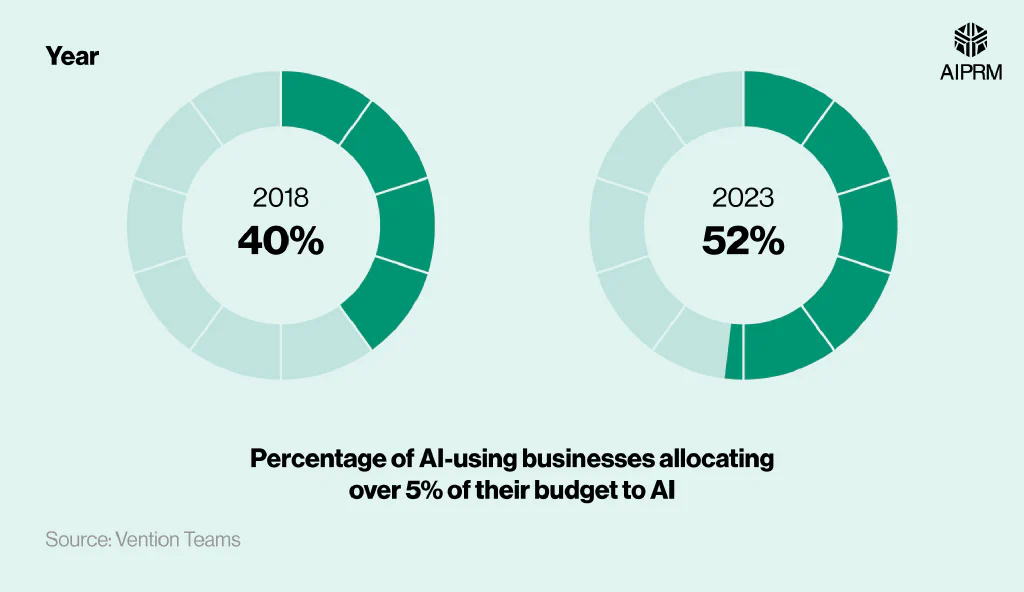
The prominence of AI can be seen in business outlay, with over half (52%) of AI-using companies in 2023 allocating more than 5% of their budget to artificial intelligence – a rise of 12 percentage points from 2018.
With prominent generative AI tools like ChatGPT making significant strides, both in functionality and popularity since 2023, this number may now be significantly higher.
Explore the most important ChatGPT statistics and find out more about one of the leading tools in the world of generative AI.
The percentage of organizations using AI and generative AI in at least one business function, 2017-24 #
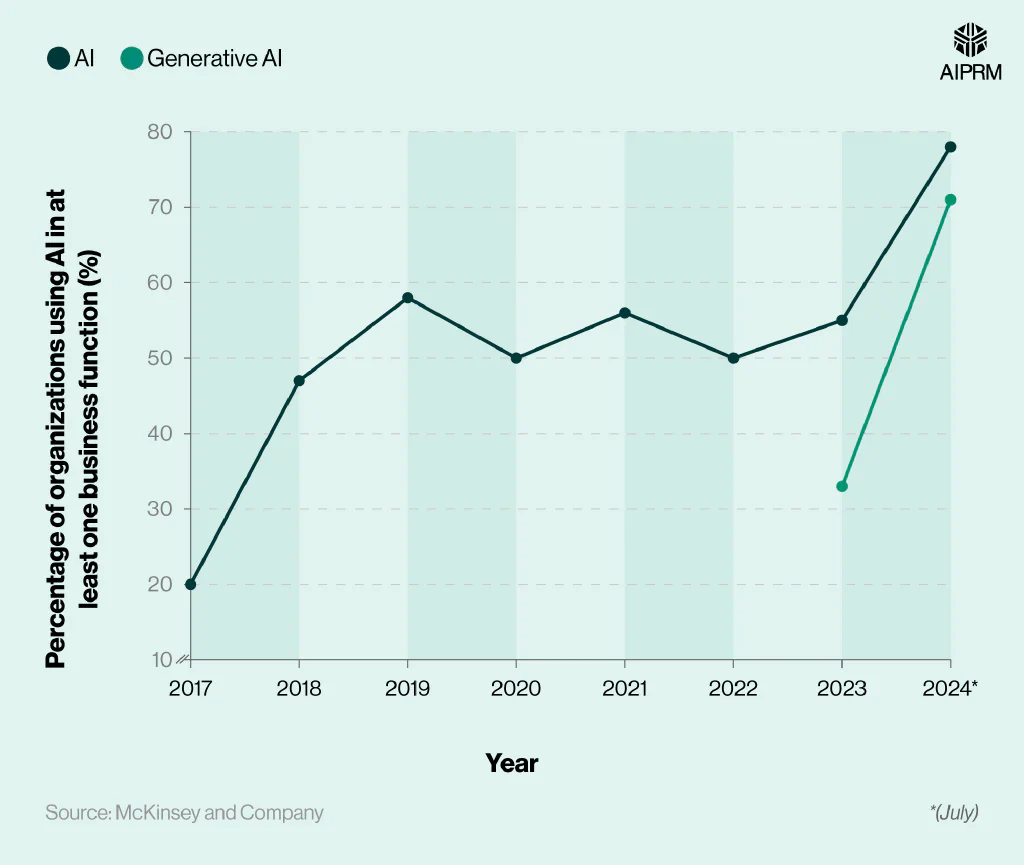
AI adoption statistics from McKinsey and Company found that 78% of companies use artificial intelligence in at least one of their business functions, as of July 2024. This represents a rise of 23 percentage points from 2023 and is nearly four times the total from 2017.
The number of businesses using AI for at least one function more than doubled between 2017 and 2018, before fluctuating from 2019 to 2022. Since 2023, however, this figure has climbed rapidly, with the latest number for 2024 representing a climb of 28 percentage points from two years previously.
The generative AI boom is also highlighted by these figures, with 71% of organizations using the technology in at least one business function in July 2024 – more than double the total from 2023.
Additionally, AI statistics revealed that in a survey conducted by Microsoft, 79% of SME owners wanted to learn more about the benefits of AI in the workplace and how it could be applied to their business.
AI Adoption rate by industry #
Strategy and corporate finance, service operations and risk were the most common departments facing AI adoption across all industries in 2024. Over a fifth (21%) of surveyed companies were using AI for strategy and corporate finance, two percentage points more than risk and service operations.
Service operations were the most AI-focused area among business, legal, and professional service companies, with 20% of organizations in these industries utilizing AI for this purpose. This was also the most popular operation for AI use among consumer goods and retail companies, with nearly a third (31%) employing AI for this function.
The percentage of businesses adopting AI by industry and department, 2024 #
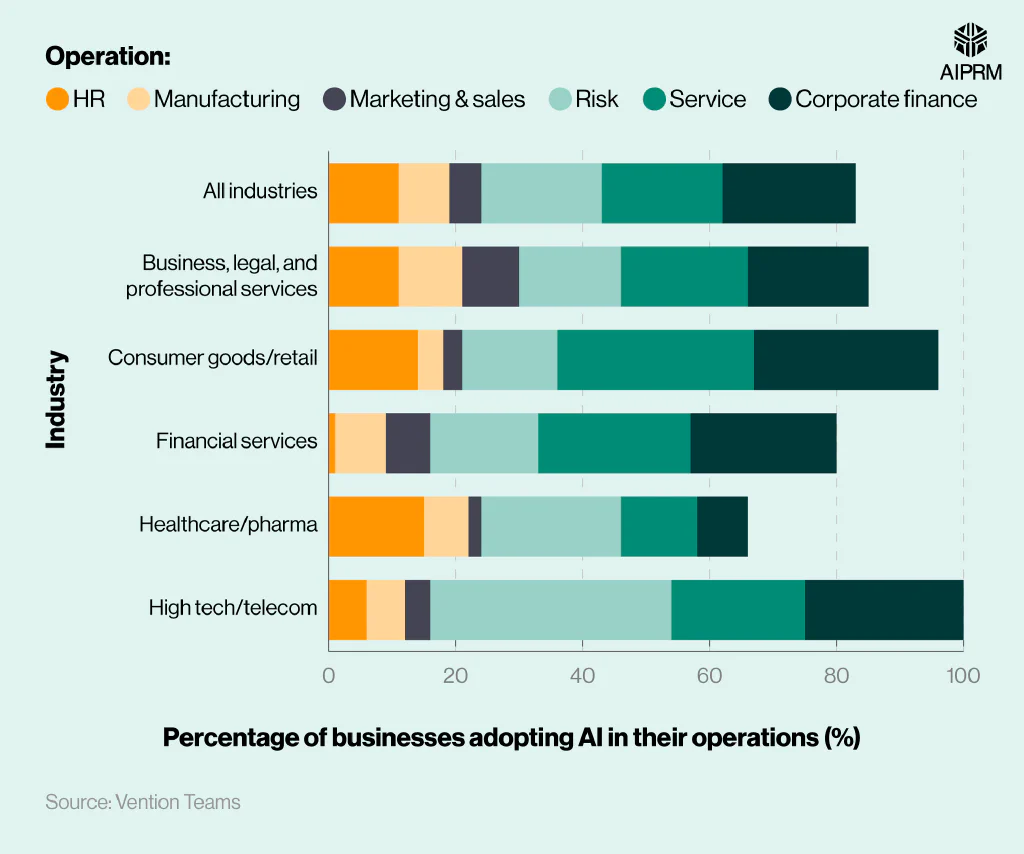
Risk management was the most common reason for AI use among high-tech and telecom companies, used by 38% of organizations. This was the highest usage rate for any operation across all industries, with risk management also the most common use among healthcare and pharma companies (22%).
How many business functions are using AI? #
Analysis of AI adoption statistics shows that 78% of businesses used AI in at least one business function in the second half of 2024. This is a rise of six percentage points from the first half of the year and is 28 percentage points more than in 2022.
At the same time, the number of businesses using AI in two or more functions has accelerated from 50% in the first half of 2024 to nearly two-thirds (63%) in the second half.
Percentage of Organizations using AI in One or More Business Functions, 2021–2024 #
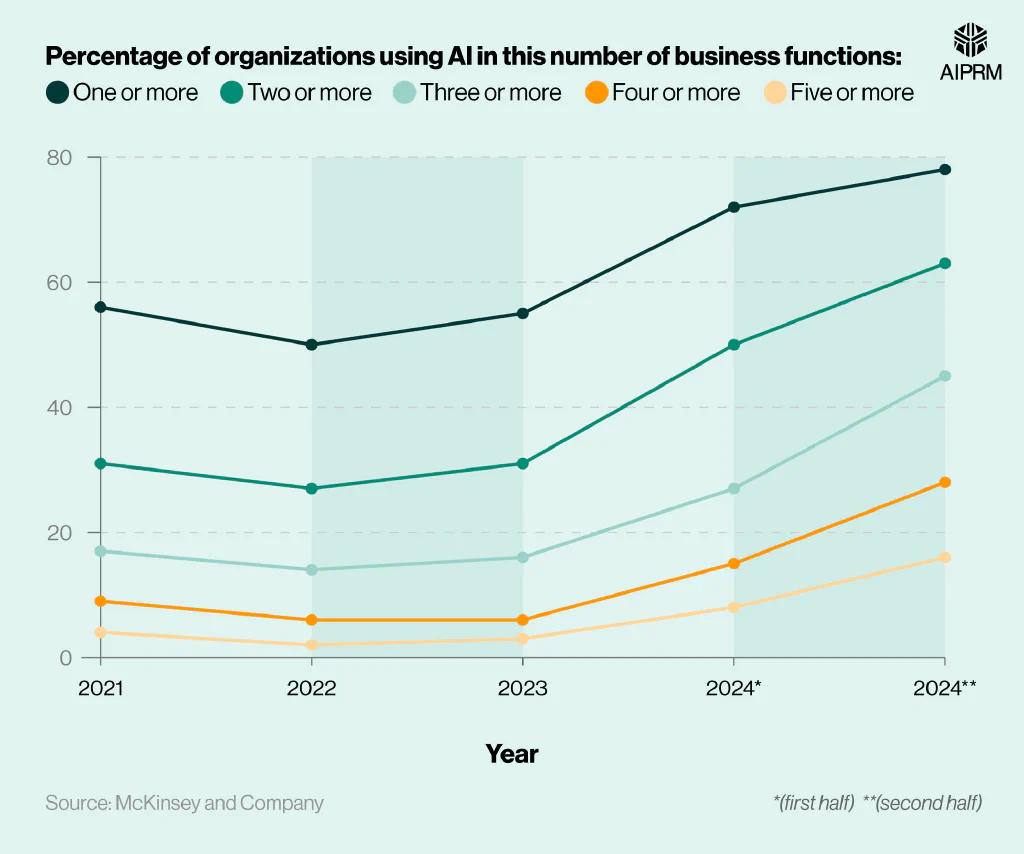
Over two in five (45%) organizations used AI in at least three business functions in the second half of 2024, nearly triple the total from 2022 (14%). At the same time, the number of companies using AI in four or more areas more than quadrupled from 6% in 2022 to 28% in the second half of 2024.
The biggest increases can be seen among the heaviest AI users, with 16% using the technology in five or more business functions in the second half of 2024 – eight times more than in 2022.
What are the top ten factors driving AI adoption? #
Technological improvements are the key variable driving AI usage, with over two-fifths (43%) of companies referencing greater accessibility from AI advancements as a driving factor in their AI adoption.
This was one percentage point more than those who cited reduced costs and the desire to automate key processes, and 12 more than the number who referenced competitive pressure.
The most common factors driving AI adoption among surveyed businesses #
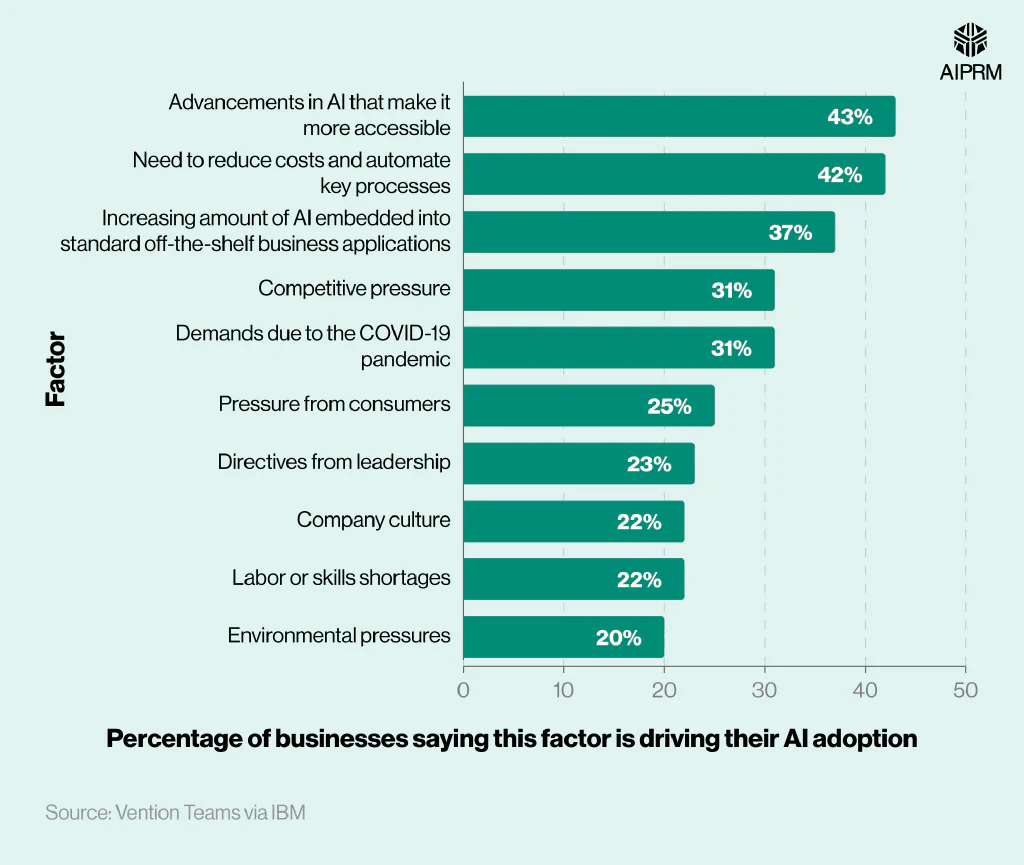
At the other end of the scale, just one in five companies cited environmental pressures as a driving factor for their AI adoption, less than half the number that cited improved accessibility.
How is AI adoption affecting the workplace? #
Over two in five (44%) companies reskilled between 0% and 5% of their workforce due to AI use between July 2023 and July 2024. This was more than double the next highest amount, with 18% of companies reskilling 6-10% of their workforce.
Overall, this means that 55% of companies reskilled at least 6% of their workforce in AI over this period.
Number of AI-using companies reskilling employees in AI, by workforce share #
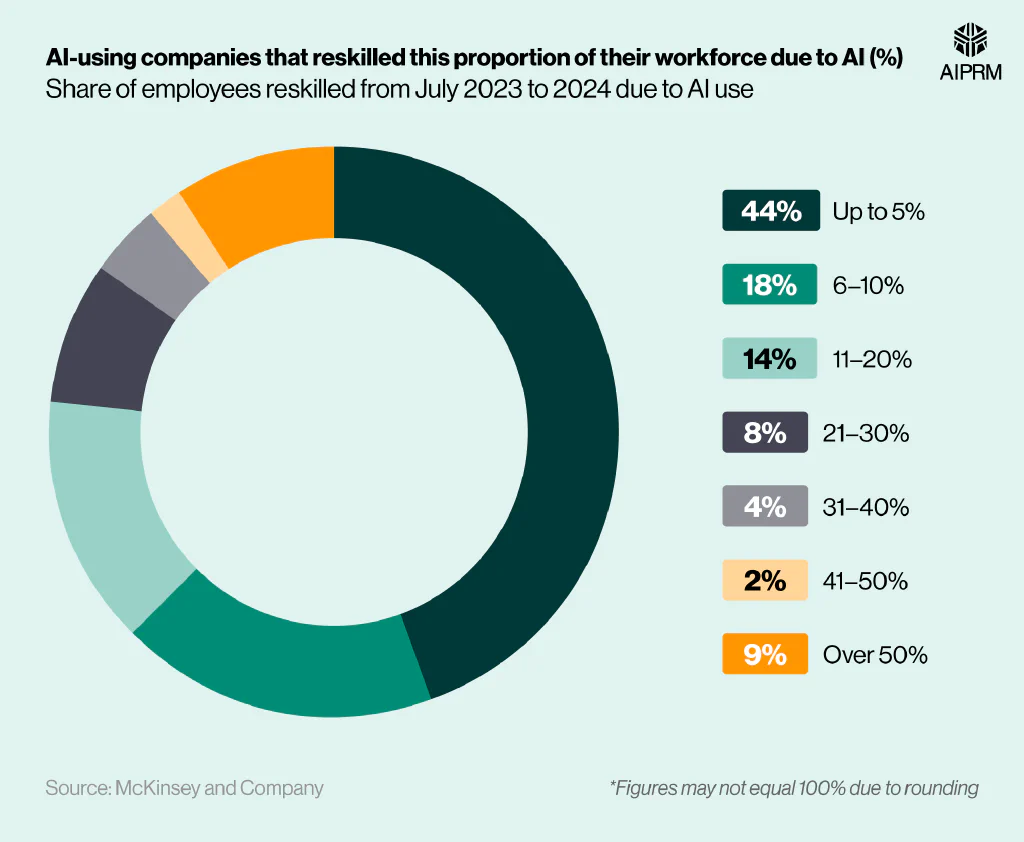
The percentage of companies gradually declines as the workforce share increases, with 8% reskilling 21 to 30% of the workforce and just 2% reskilling between 41 and 50%.
However, this trend reverses for the highest group, with 9% of companies reskilling over half of their workforce, over four times more than the number that reskilled 41 to 50%. This suggests that there is a strong core of companies actively embracing AI adoption at a quicker rate than the rest of society.
Number of AI-using companies planning to reskill employees in AI, by workforce share #
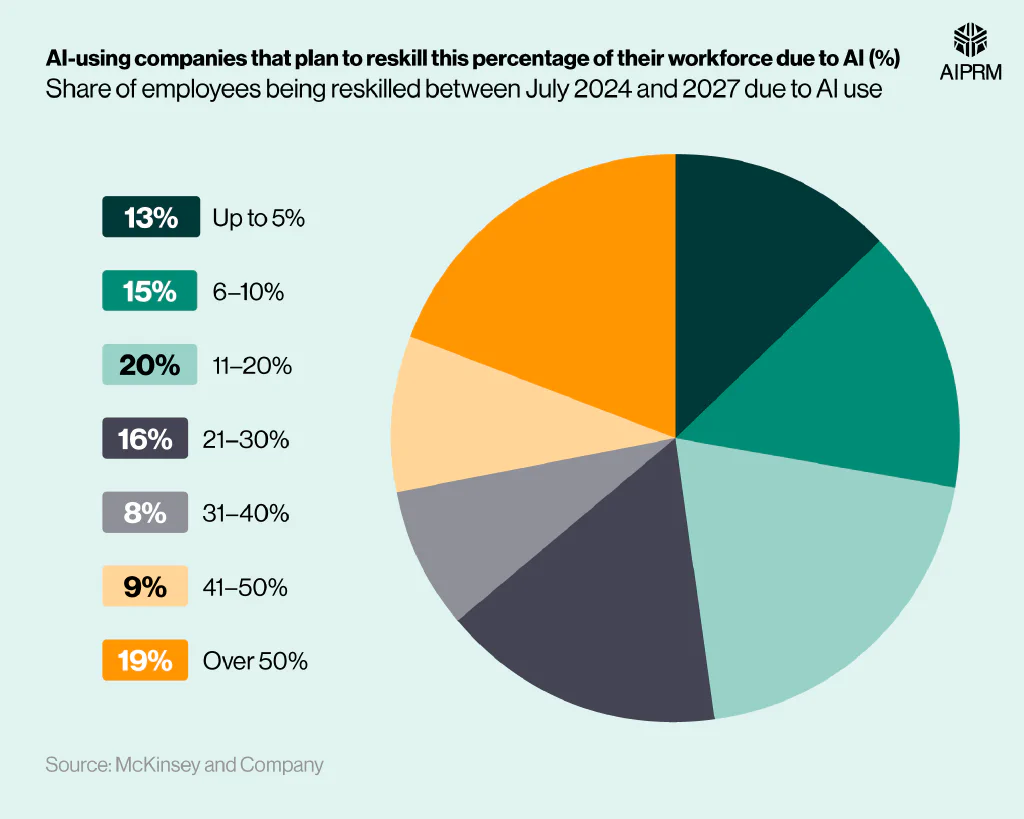
A fifth of companies plan to reskill 11-20% of their workforce for AI adoption between 2024 and 2027, making this the most common share cited by survey respondents.
A further 19% planned on retraining more than half of their workforce, suggesting that AI adoption will have a profound impact on many companies’ day-to-day operations over the next few years.
Change in the number of employees #
Nearly two in five (38%) businesses expect AI integration to have no impact on headcount, according to AI adoption stats from McKinsey. This is more than four times the number predicting a workforce decline of over 20%, and nearly eight times the total anticipating a rise of over 20%.
When broken down by business function, “no change” was the most common response for 10 of the 11 surveyed areas, with supply chain and inventory management being the only exception.
The expected employment change from AI adoption by business function, 2024 #
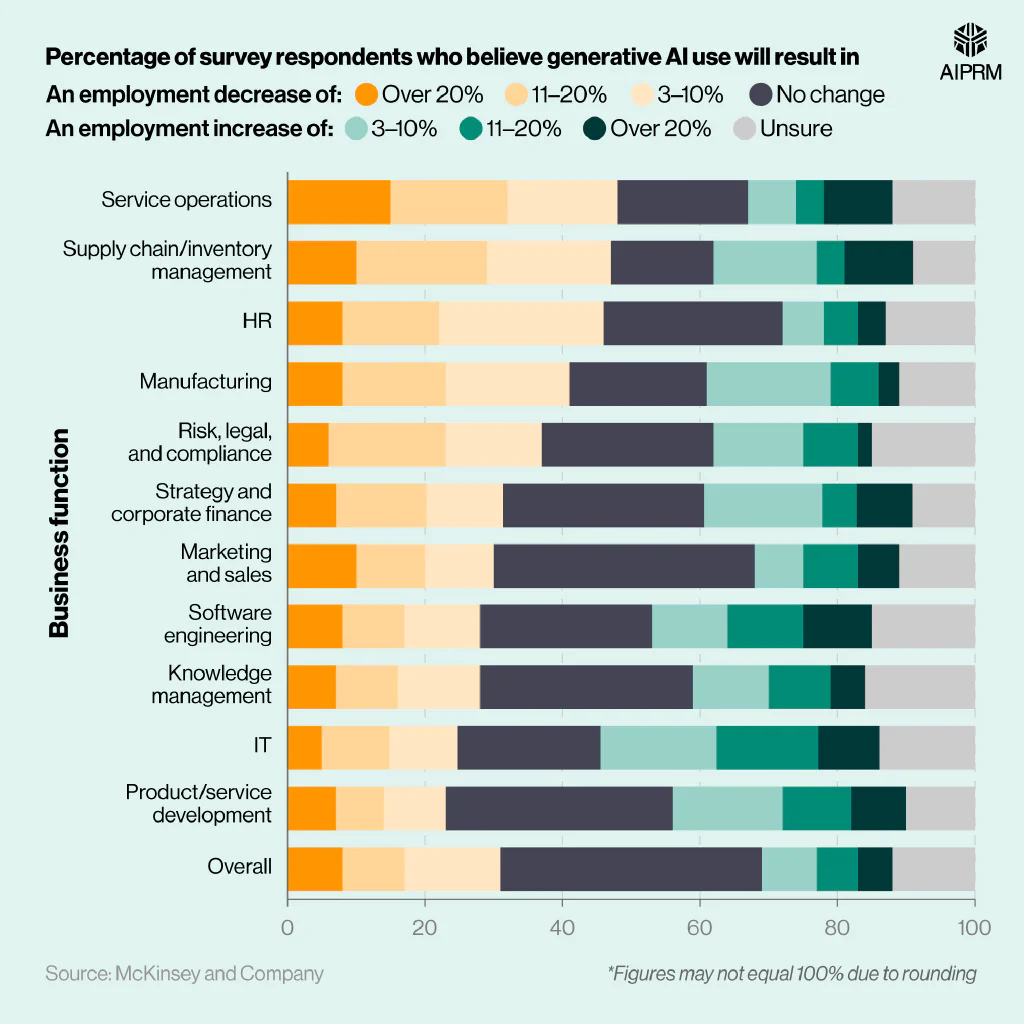
Service operations were most likely to anticipate job losses, with 48% expecting an AI-related employment decrease of some level. Within that, 15% expect a drop of over 20%.
By contrast, IT was the area most likely to anticipate workforce increases, with 41% predicting employment rises of some degree.
Generative AI adoption statistics #
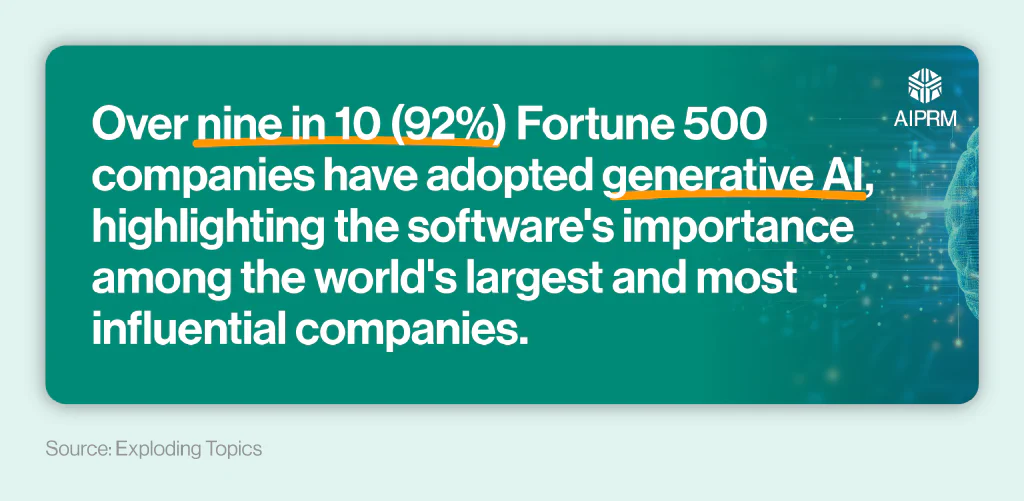
AI adoption statistics from Exploding Topics revealed that 92% of Fortune 500 companies have adopted generative AI, highlighting the impact of the technology among the world’s largest and most influential companies.
Additionally, there are over four million software developers (mostly from Fortune 500 companies) building on OpenAI’s API.
The same report states that almost nine in 10 US jobs could be impacted by generative AI, with 73% of marketing departments already deploying it.
The report also found that:
- Nearly two-thirds (64%) of executives want to adopt generative AI
- Just 3% of the skills required for software engineering are resistant to generative AI
- Generative AI could benefit the economy by up to $7.9 trillion per year.
Elsewhere, a report from Salesforce found that nearly two-thirds of generative AI users are either Millennials or Gen Z, suggesting that the younger generations are at the forefront of generative AI adoption.
Additionally, nearly 60% of users felt they were on their way to mastering the technology, with 52% saying their usage had increased from when they’d started.
Discover the latest developments on AI in employment by visiting our comprehensive AI replacing jobs statistics page.
What are the most common business functions incorporating generative AI? #
Marketing-sales is the leading business area adopting generative AI, with 42% of businesses regularly using it for these purposes. This is 14 percentage points more than the next most common use, and the only one where adoption rates exceed 30%.
The percentage of businesses regularly using generative AI for various functions #
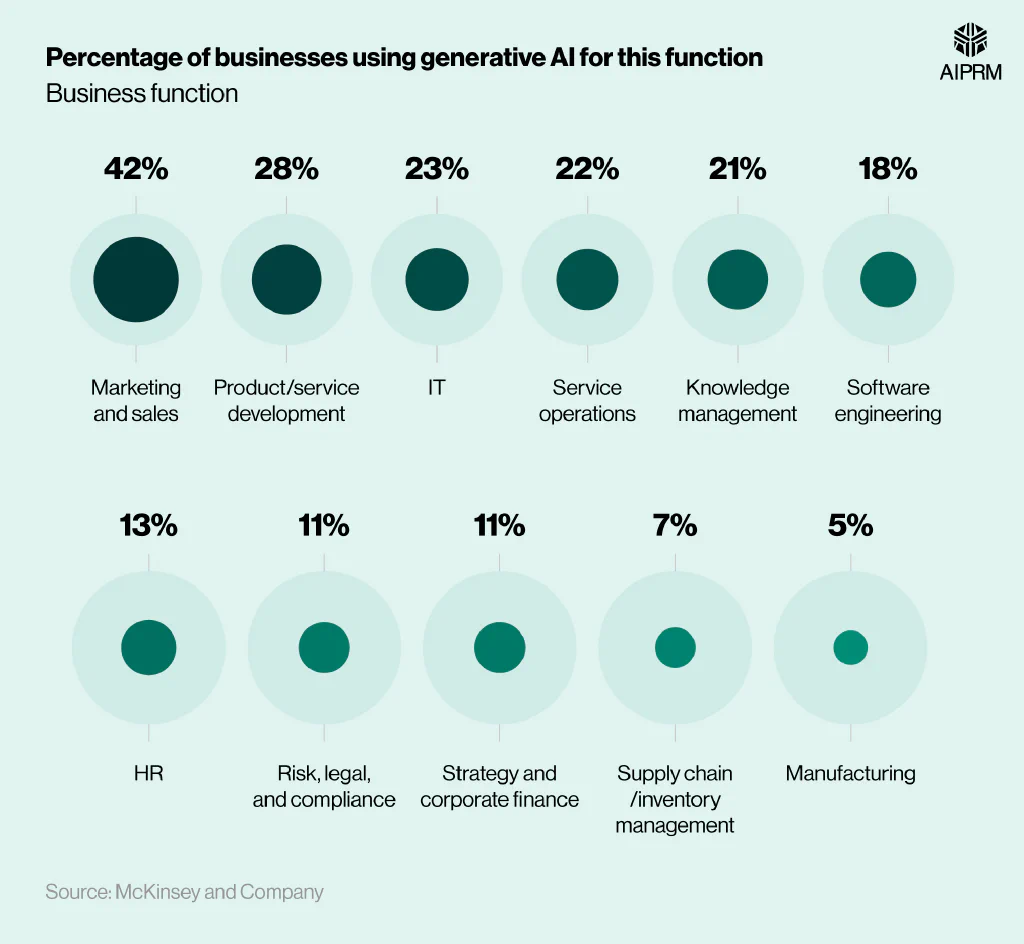
Product-service development was the next most common function, with 28%, making it the final one embracing generative AI in over a quarter of companies. There are three more functions regularly using generative AI in more than a fifth of organizations
- IT (23%)
- Service operations (22%)
- Knowledge management (21%)
At the other end of the scale, just one in twenty businesses regularly use generative AI for manufacturing purposes, over eight times less than those employing it for marketing and sales.
According to generative AI statistics, Bloomberg Intelligence forecasts the generative AI market could grow to roughly $1.3 trillion by 2032.
What are the most common types of content being created with generative AI? #
Nearly two-thirds (63%) of companies have created text-based content using generative AI, making this the most common content type among businesses. This was nearly double the total of the next highest type, with 36% using the technology to create images.
The most common types of content created by businesses using generative AI #
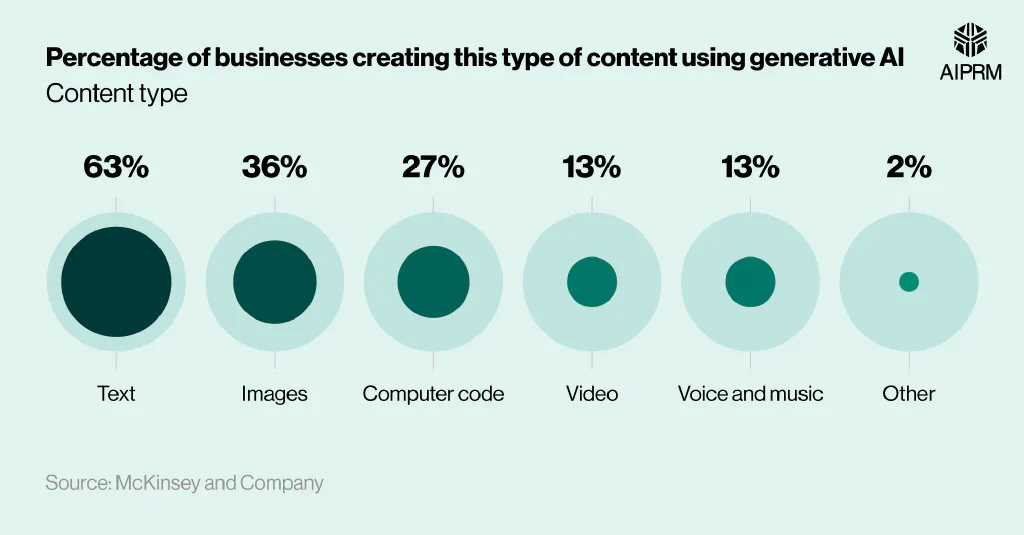
Computer code was the next most common use, at 27%, making this the final content type created by more than a quarter of businesses using generative AI.
Video and voice-music shared fourth place, with each employing generative AI in 13% of businesses. This was less than half the total for computer code and almost five times less than text-based content.
The benefits of AI adoption #
Over nine in 10 (92.1%) firms claimed they benefited from AI adoption in 2023, marking a rise of nearly 22 percentage points (up from 70.3%) from three years previously.
The percentage of firms that benefit from AI adoption by year #
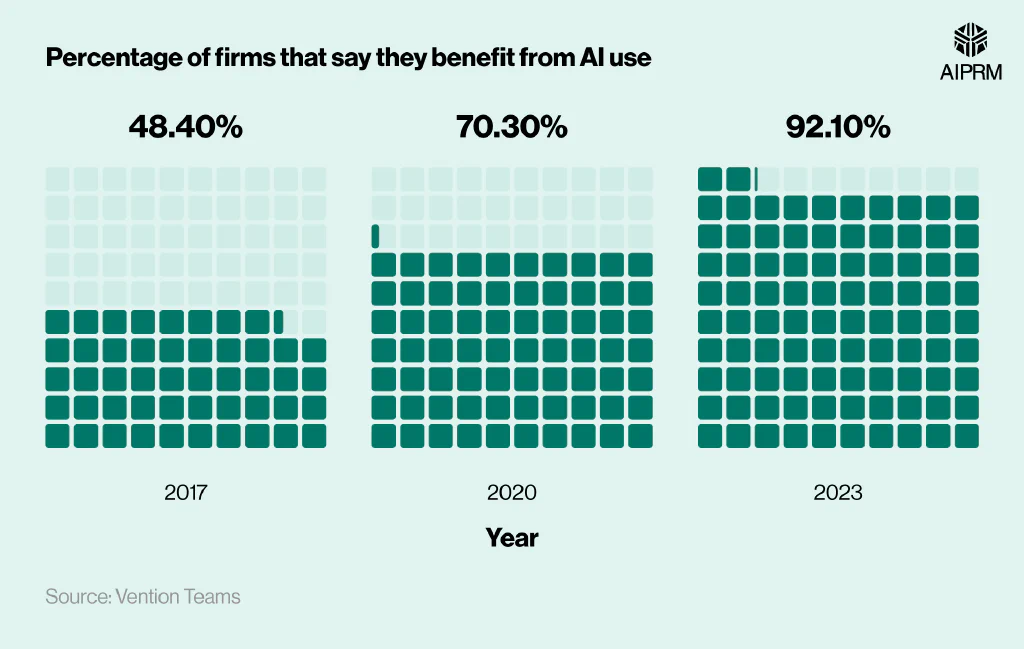
The number of companies feeling the benefits from AI adoption has risen consistently since 2017, when the number stood at less than half (48.4%). A rise of nearly 22 percentage points took the total to 70.3% in 2020, with a similar increase taking the number past 92% by 2023.
This means the number of companies benefitting from AI adoption rose by 43.7 percentage points between 2017 and 2023.
What areas of business are seeing the biggest benefits from generative AI? #
Seven in 10 businesses reported seeing revenue increases in their strategy and corporate finance departments from generative AI use, between July 2023 and July 2024. This was the highest total of any business function, with two-thirds reporting revenue increases in their supply chain and inventory management.
Though strategy and corporate finance had the highest number of businesses reporting revenue increases, only 11% experienced rises of more than 10%. This was eight percentage points fewer than supply chain and inventory management (19%), with only marketing and sales recording a lower total (8%).
The percentage of businesses reporting revenue increases due to generative AI use, by business function, 2023-24 #
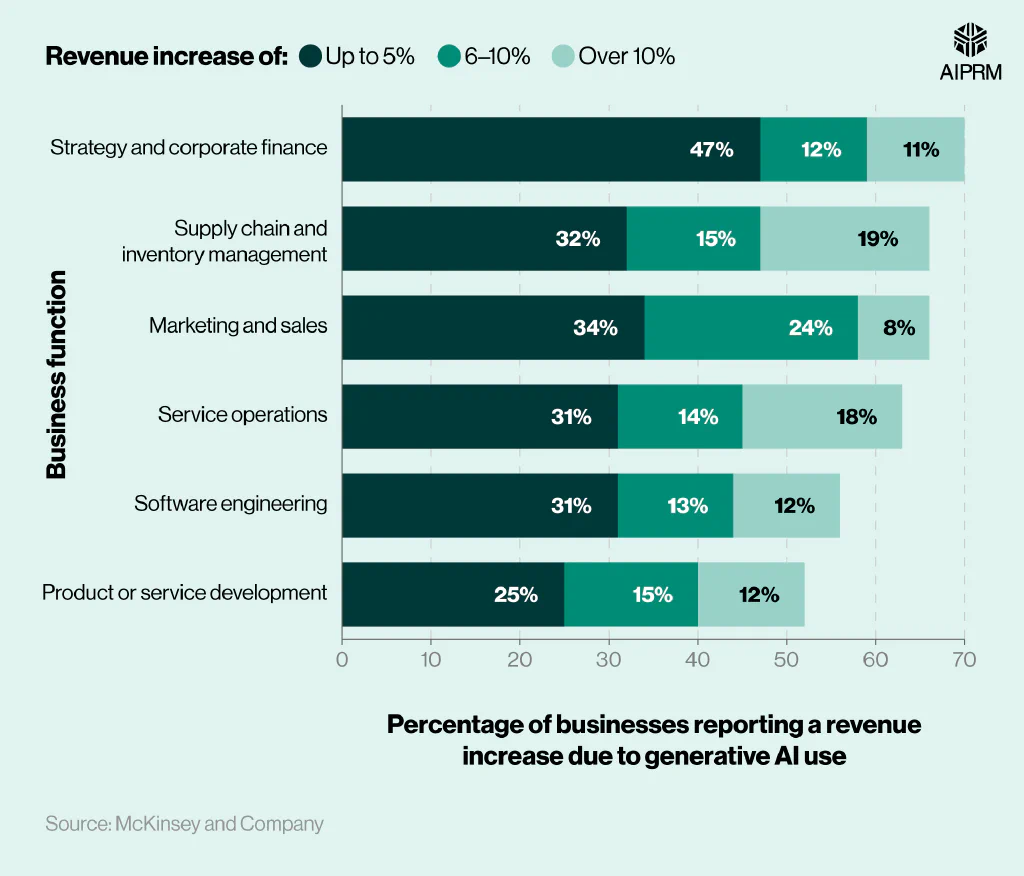
Product-service development had the lowest number of companies reporting generative AI-related revenue spikes, at 52%. Despite this, 27% of businesses experienced rises of at least 6% in this area, four percentage points more than in strategy and corporate finance.
The percentage of businesses reporting cost decreases due to generative AI use by business function #
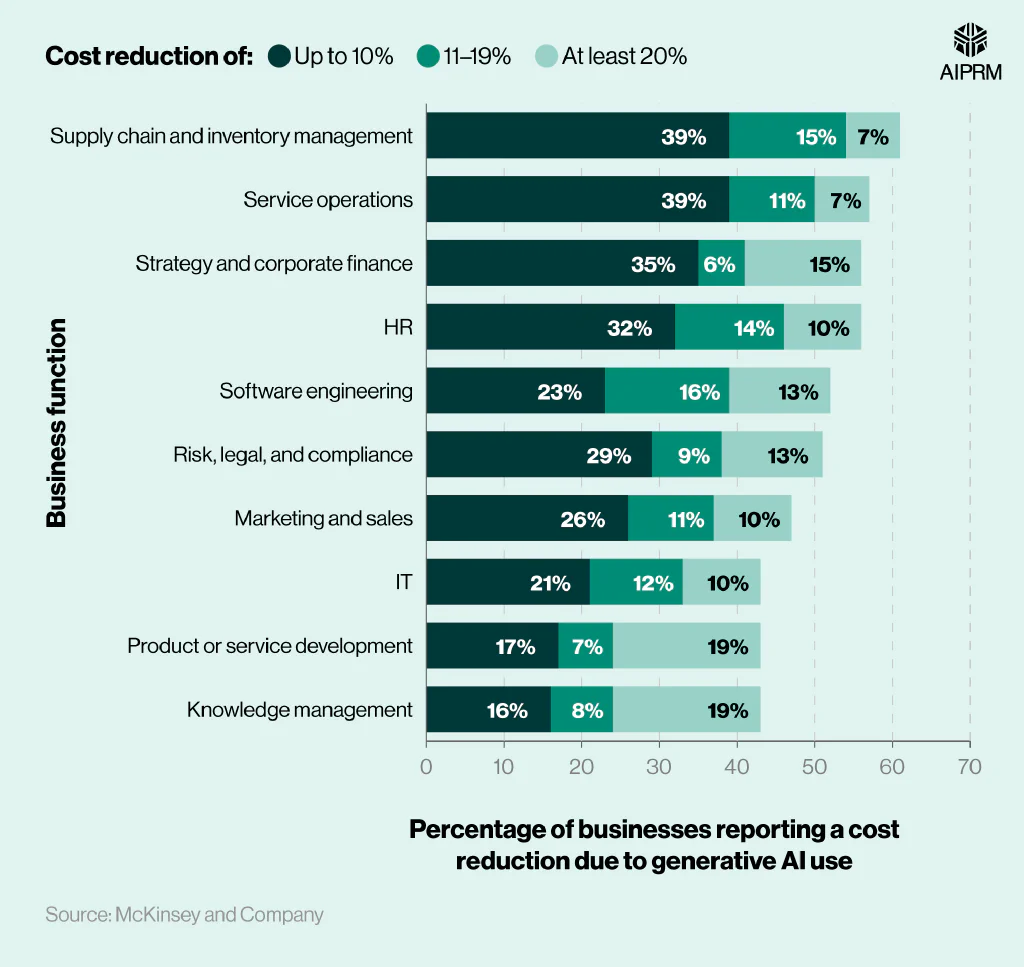
According to AI adoption statistics from McKinsey, supply chain and inventory management is the business function benefiting the most from cost reductions through generative AI use. 61% businesses reported savings in this area, with 22% cutting costs by at least 11%.
By contrast, 43% of companies managed to cut costs in product-service development and knowledge management, 18 percentage points fewer than in supply chain and inventory management. Despite this, these functions had the highest number of businesses achieving cost reductions of at least 20%, with both recording totals of 19%.
AI adoption rate by country #
A report from the Visual Capitalist, based on data from the International Monetary Fund (IMF), found that Singapore is the most prepared country for AI adoption, with a score of 0.8 out of 1.
AI preparedness is determined by scoring each country on the following factors:
- Digital infrastructure
- Human capital
- Technological innovation
- Legal frameworks
Denmark had the next highest score at 0.78, with the United States and Netherlands sharing third place (0.77).
The top 10 countries for AI preparedness #
| Country | AI Preparedness Index Score (0-1) |
|---|---|
| Singapore | 0.80 |
| Denmark | 0.78 |
| United States | 0.77 |
| Netherlands | 0.77 |
| Estonia | 0.76 |
| Finland | 0.76 |
| Switzerland | 0.76 |
| New Zealand | 0.75 |
| Germany | 0.75 |
| Sweden | 0.75 |
(Source: Visual Capitalist via IMF)
The data shows a dominance among European countries for AI preparedness, with 70% of the top 10 based on the continent. Despite topping the list, Singapore is the only Asian country represented in the top 10, with the United States and New Zealand being the only other non-European nations.
The 12 countries with the lowest levels of AI preparedness #
| Country | AI Preparedness Index Score (0-1) |
|---|---|
| South Sudan | 0.11 |
| Afghanistan | 0.13 |
| Central African Republic | 0.18 |
| Somalia | 0.20 |
| Mauritania | 0.23 |
| Sudan | 0.23 |
| Chad | 0.23 |
| Libya | 0.24 |
| Democratic Republic of the Congo | 0.25 |
| São Tomé and Príncipe | 0.25 |
| Ethiopia | 0.25 |
| Comoros | 0.25 |
(Source: Visual Capitalist via IMF)
Africa dominates the list of the least prepared countries for AI adoption, with 11 of the 12 lowest-scoring countries based on the continent. Of these, South Sudan has the lowest preparedness score, at 0.11 out of 1. This was 0.02 lower than the next lowest scoring nation (Afghanistan) and over seven times less than the leading Singapore.
AI adoption rate by region #
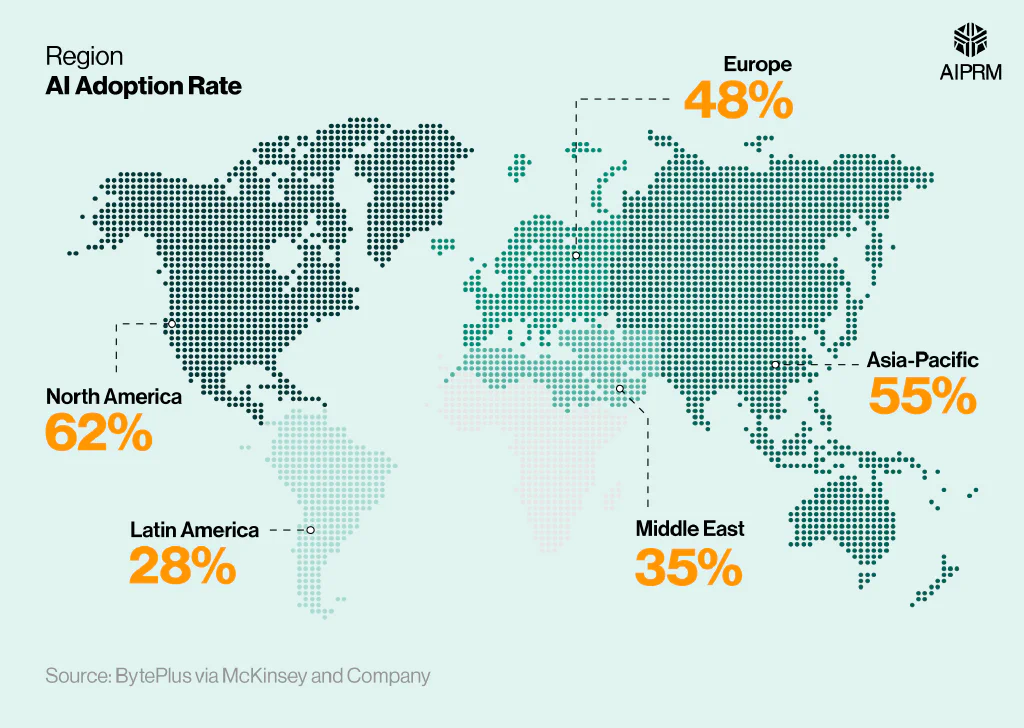
North America leads the way for AI adoption with 62% of companies embracing the technology, according to a 2025 report from BytePlus. This is seven percentage points higher than Asia, which was the only other continent with an adoption rate exceeding 50%.
At the other end of the scale, the AI adoption rate in Latin America stood at just 28%, less than half the total for North America.
AI adoption challenges #
Despite the many benefits of AI adoption, both in and out of the workplace, the transition to this technology also comes with considerable challenges. 76% of business leaders said they struggle to implement AI, with around 46% of AI pilot projects failing to reach production.
A further 15% of businesses cited regulatory hurdles as an obstacle to AI adoption, with 18% feeling they lack an AI strategy. Finance was another challenge referenced, with 19% of organizations facing budget constraints relating to AI integration.
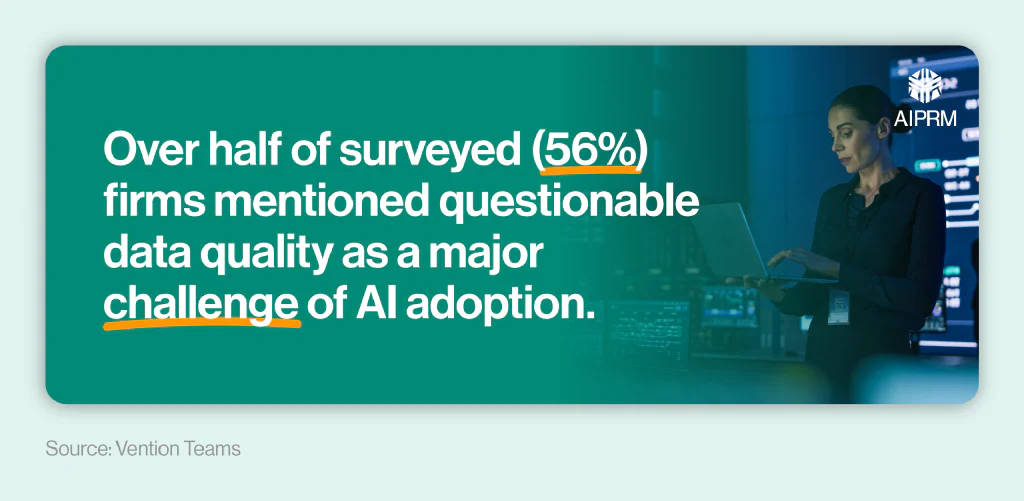
Additionally, data quality was a significant concern among businesses, with 56% citing this as a major challenge for AI adoption. A separate report from Salesforce found that 64% of full-time workers said they would use generative AI if it was safer and more secure, with 45% claiming they’d adopt it if it could integrate into the technologies they already use.
While AI adoption has already transformed the workplace in many sectors, these stats highlight the level of growth needed for full integration. If concerns around accessibility, reliability, and output are effectively addressed, AI adoption will likely continue to accelerate in the coming years.
FAQs #
What is AI adoption?
AI adoption is the practice of integrating artificial intelligence technologies into business processes, operations, products, or services. The purpose of AI adoption is to use the technologies’ unique capabilities to improve output, efficiency, and decision-making within the workplace.
AI adoption can take place in numerous forms, from investing in software, developing infrastructure, training employees, and changing workflows.
Is AI good for society?
AI has already benefitted our society in numerous ways, from automating tasks to driving efficiency and solving key issues in industries like healthcare, education, and communications. These benefits are only likely to strengthen as AI’s capacity improves, resulting in greater speeds and higher-quality output.
However, AI adoption also raises significant concerns for society around job displacement, accuracy, data privacy, bias, and plagiarism. As such, the position of AI as a force for good in society will depend on developers’ abilities to mitigate against these challenges, and how global industries evolve to cope with an AI-reliant world.
How is AI used in business?
AI is used across an array of businesses to automate tasks, improve efficiency, and enhance decision-making and problem-solving. The exact nature of AI in the workplace can vary significantly based on the demands of a specific job or industry.
Common use areas for AI in business include chatbots for customer service, ideation for product development, automating communications tasks, fraud detection, and personalized marketing.
What is a critical factor in the successful adoption of AI in business?
A key factor in successful business AI adoption is having a clear strategy that aligns AI use with your business objectives. This includes setting measurable goals, developing a sufficient training plan, mitigating risks, and encouraging employee buy-in.
It’s equally important to ensure you have the right talent and resources available to further AI adoption within your company. By employing people with the right skillsets and having the appropriate software, you arm your company with everything it needs to build a culture of AI adoption that can be strengthened among new and existing employees.
What are some of the new or enhanced risks due to the increasing adoption of hybrid cloud and AI?
The rise of hybrid cloud and AI can increase the risk in areas such as data privacy, security, and compliance. Confidential and sensitive data stored in multiple locations can be harder to protect, creating more entry points for attackers and increasing the likelihood of data breaches.
Additionally, AI systems also come with their own risks, like inaccurate information, algorithmic bias, plagiarism, and a lack of transparency in sourcing.
Managing these risks will require a combination of robust government legislation, technological development, and cybersecurity to ensure the benefits of these technologies continue to outweigh the negatives in society.
What is AI adoption?
AI adoption is the practice of integrating artificial intelligence technologies into business processes, operations, products, or services. The purpose of AI adoption is to use the technologies’ unique capabilities to improve output, efficiency, and decision-making within the workplace.
AI adoption can take place in numerous forms, from investing in software, developing infrastructure, training employees, and changing workflows.
Is AI good for society?
AI has already benefitted our society in numerous ways, from automating tasks to driving efficiency and solving key issues in industries like healthcare, education, and communications. These benefits are only likely to strengthen as AI’s capacity improves, resulting in greater speeds and higher-quality output.
However, AI adoption also raises significant concerns for society around job displacement, accuracy, data privacy, bias, and plagiarism. As such, the position of AI as a force for good in society will depend on developers’ abilities to mitigate against these challenges, and how global industries evolve to cope with an AI-reliant world.
How is AI used in business?
AI is used across an array of businesses to automate tasks, improve efficiency, and enhance decision-making and problem-solving. The exact nature of AI in the workplace can vary significantly based on the demands of a specific job or industry.
Common use areas for AI in business include chatbots for customer service, ideation for product development, automating communications tasks, fraud detection, and personalized marketing.
What is a critical factor in the successful adoption of AI in business?
A key factor in successful business AI adoption is having a clear strategy that aligns AI use with your business objectives. This includes setting measurable goals, developing a sufficient training plan, mitigating risks, and encouraging employee buy-in.
It’s equally important to ensure you have the right talent and resources available to further AI adoption within your company. By employing people with the right skillsets and having the appropriate software, you arm your company with everything it needs to build a culture of AI adoption that can be strengthened among new and existing employees.
What are some of the new or enhanced risks due to the increasing adoption of hybrid cloud and AI?
The rise of hybrid cloud and AI can increase the risk in areas such as data privacy, security, and compliance. Confidential and sensitive data stored in multiple locations can be harder to protect, creating more entry points for attackers and increasing the likelihood of data breaches.
Additionally, AI systems also come with their own risks, like inaccurate information, algorithmic bias, plagiarism, and a lack of transparency in sourcing.
Managing these risks will require a combination of robust government legislation, technological development, and cybersecurity to ensure the benefits of these technologies continue to outweigh the negatives in society.
Glossary #
AI adoption #
AI adoption is the process of integrating business operations, products, and services with artificial intelligence.
Generative AI #
Generative AI is a type of artificial intelligence that uses large language models (LLMs) and other deep learning techniques to create new content based on patterns learned from existing data sets. It can generate content in response to human prompts, with common types including text, images, audio, video, and code.
Hybrid Cloud #
A hybrid cloud is a computing environment that combines both public and private cloud spaces, allowing data to be shared between them.
Sources #
https://ventionteams.com/solutions/ai/adoption-statistics
https://www.aiprm.com/ai-statistics/
https://www.mckinsey.com/capabilities/quantumblack/our-insights/the-state-of-ai
https://explodingtopics.com/blog/generative-ai-stats
https://www.salesforce.com/news/stories/generative-ai-statistics/
https://www.aiprm.com/generative-ai-statistics/
https://www.visualcapitalist.com/mapped-which-countries-are-most-prepared-for-ai/