50+ OpenAI Statistics 2025
Founded in 2015, OpenAI is a company devoted to developing artificial general intelligence (AGI), a technology described by the company as “highly autonomous systems that outperform humans at most economically valuable work”. In furthering this technology, OpenAI has committed itself to offering “safe and beneficial” AI.
This OpenAI statistics report examines the company’s success since its inception, including data on OpenAI’s market value, revenue, stock value (or what this would be if shares in the company could be purchased), and the future of OpenAI’s technology.
Top 10 must-read OpenAI statistics #
- As of April 2025, OpenAI is reported to be worth around $300 billion, nearly double (+91%) the valuation from October 2024.
- OpenAI’s annual recurring revenue is projected to surpass its originally predicted total of $12.7 billion in 2025.
- Between April and June 2025, YouTube accounted for the most traffic driven to the OpenAI site across social media-related platforms, at 42.18%.
- Between April and June 2025, the United States generated the biggest share of traffic (14.13%) to OpenAI’s website.
- OpenAI’s website is estimated to have received 663.6 million monthly visits, on average, between April and June 2025.
- Those aged 25-34 had the biggest share (28.84%) of OpenAI website users from April to June 2025.
- Small-sized companies are the biggest users of OpenAI (1,415 companies with 10-50 employees and 1,643 companies with a revenue of $1-$10 million).
- As of June 2025, monthly visits to ChatGPT stood at nearly 5.4 billion.
- 14.72% of ChatGPT users were based in the US between April and June 2025.
- Nearly 54% of OpenAI website users are male.
OpenAI company statistics #
Launched initially as a nonprofit, OpenAI transitioned to a capped for-profit model in 2019 to grant employees a stake in the company and to legally attract investment from venture funds. As a result, the organization is now led by the non-profit OpenAI, Inc, which has multiple for profit subsidiaries including OpenAI Global, LLC.
The company initially intended to raise $1 billion in donation commitments, but these contributions amounted to only $130.5 million. Following the shift to a capped for-profit model, Microsoft began a partnership with the company, with an investment of $1 billion.
X’s owner, Elon Musk, was involved in co-founding OpenAI, though reports of his financial contribution to the company vary. Musk originally claimed to have pledged $1 billion before clarifying that he gave $100 million instead.
TechCrunch later disputed this, saying the figure was closer to $15 million, to which Musk stated he donated about $50 million. Musk left the board of OpenAI in 2018 to avoid possible conflict with his role as CEO of Tesla, where they are actively integrating AI into their products.
How much is OpenAI worth? #
In February 2024, The New York Times reported that OpenAI had completed a deal that valued the company at $80 billion. However, just eight months later, in October 2024, OpenAI secured an injection of $6.6 billion from a fresh funding round, leading to a $157 billion post-money valuation.
This valuation was a significant increase from 2023, when a deal enacted by Thrive Capital, Sequoia Capital, Andreessen Horowitz, and K2 Global valued the company at around $29 billion after the venture-capital firms agreed to buy company shares in a tender offer.
The funding secured in October 2024 was largely raised by returning investors Thrive Capital, Khosla Ventures, and Microsoft, as well as Nvidia, the chipmaker that pioneered graphics processing units (GPUs), a building block of AI tools.
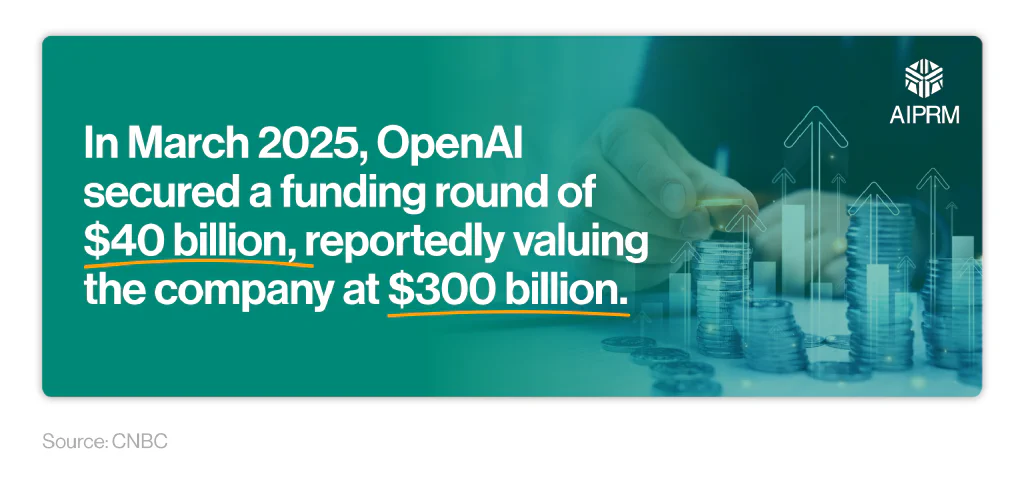
In January 2025, The Wall Street Journal reported that OpenAI was in early talks to secure funding in the region of $40 billion, which could value the company up to $300 billion. The funding was officially secured in March 2025.
Also in January 2025, OpenAI announced Project Stargate. Backed by a group of equity funders (OpenAI, Oracle, SoftBank, and MGX), the project intends to invest $500 billion in building new AI infrastructure for OpenAI in the United States over the next four years.
How much is Sam Altman worth? #
Sam Altman is the CEO of OpenAI, providing some of the initial funding alongside other tech leaders, including Peter Thiel, Greg Brockman, and Elon Musk.
In 2019, when the company moved to a for-profit model, Altman left his role at Y Combinator to focus on his position as CEO full-time.
Although Altman remains CEO, in November 2023, he was briefly fired by the company’s board and announced as the lead of a new advanced AI research team at Microsoft. However, following letters of support from 650 employees (out of the 770 at the time), Altman was reinstated.
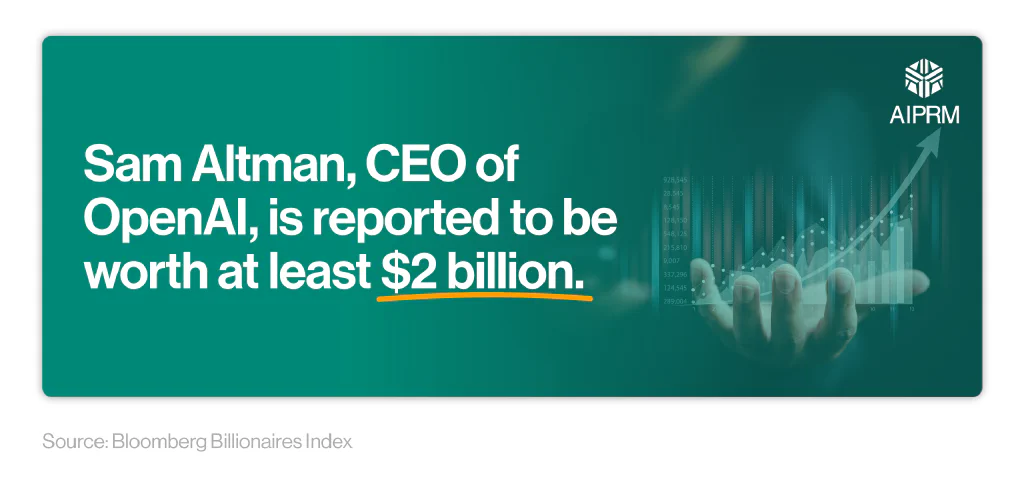
According to the Bloomberg Billionaires Index, which valued the CEO in March 2024, Altman is worth at least $2 billion.
Altman has been involved in many companies and briefly served as Reddit’s interim CEO in 2014. When Reddit announced its plans for an initial public offering in February 2024, it was revealed that Altman was the third-largest shareholder, holding 8.7% of the company’s outstanding shares.
Following OpenAI’s October 2024 funding round, it was reported that the company was looking to restructure into a for-profit entity and would be providing Altman with a 7% stake in the company. If this is to come to fruition, it could mean that Altman receives shares of over $10 billion.
OpenAI market statistics #
OpenAI revenue statistics #
The annual recurring revenue (ARR) of OpenAI was projected to skyrocket to $12.7 billion in 2025, more than tripling from the previous year. However, with tens of millions of people now paid subscribers to their products, they look set to surpass this figure, with Sacra projecting an ARR of $13 billion, as of August 2025.
The annual recurring revenue of OpenAI (2020-2025) #
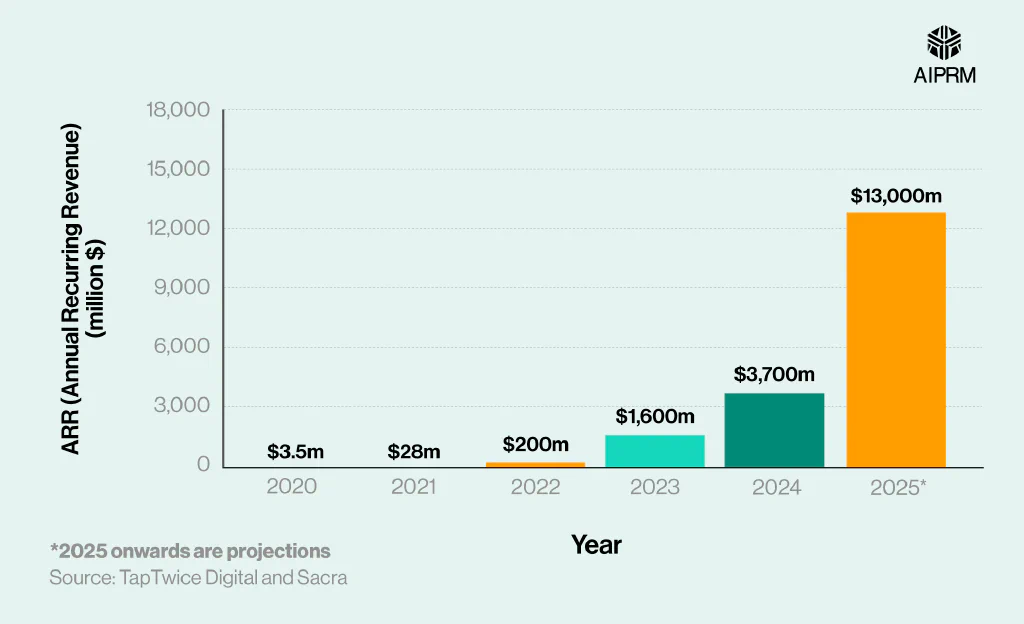
OpenAI revenue has soared since 2020, when the total was estimated at just $3.5 million, before rising to $28 million a year later (+700%). An identical percentage growth occurred between 2022 and 2023, when revenue rose from $200 million to $1.6 billion.
Despite the exponential growth in revenue, OpenAI recorded losses of approximately $5 billion in 2024, with the company reported to still be losing money in 2025.
OpenAI stock value #
As OpenAI is a private company and not traded on public stock exchanges, its official stock price is not publicly available.
According to investment company Forge Global, OpenAI shares are estimated at $469.47 as of 30 July 2025. This is an increase of around 164% from the same date a year previously, when the figure stood at $177.68. Forge Global’s share prices are not official stock market rates, and are calculated using publicly available data such as primary funding round information and secondary market transactions.
OpenAI employee statistics #
How many people work for OpenAI? #
As of 2025, OpenAI’s employee count is reported to stand at over 3,000, meaning their number of employees is over three times greater than it was just two years before.
The number of employees of OpenAI (2015-2025) #
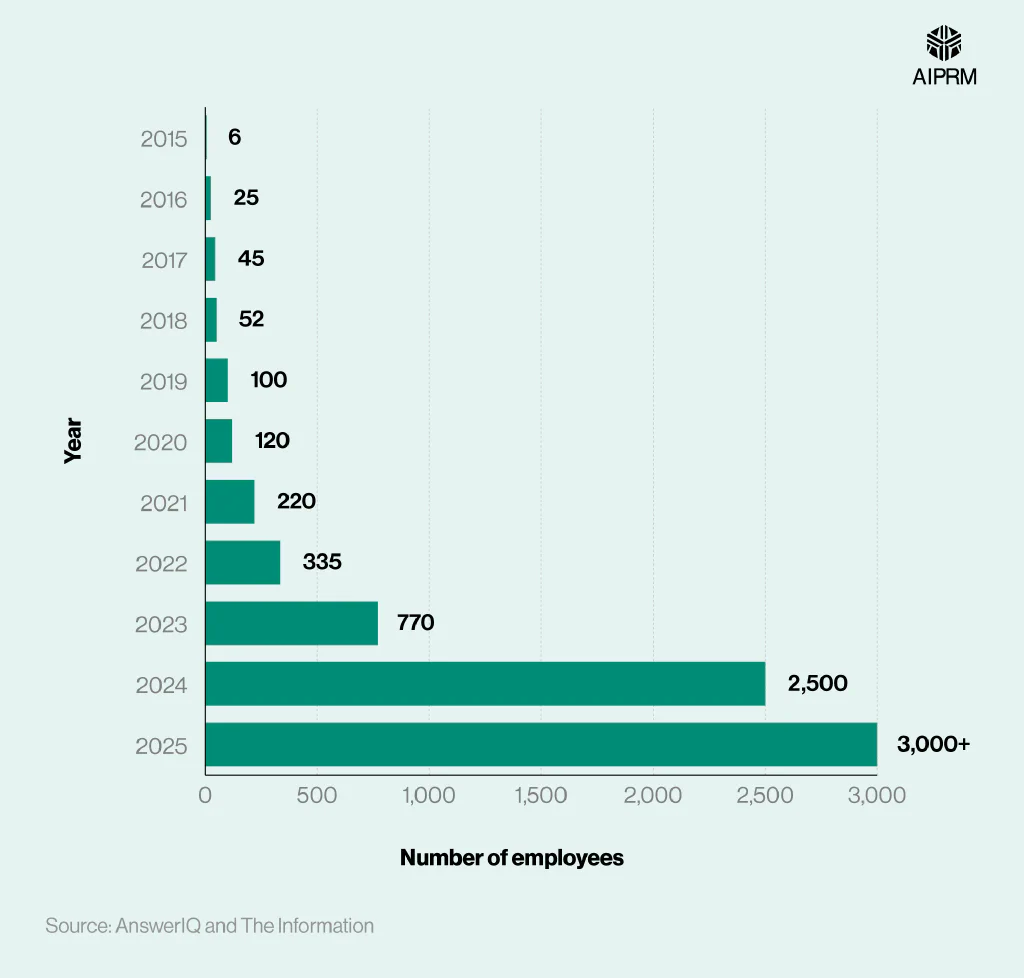
The number of employees at OpenAI steadily grew between 2015 and 2022, rising from six to 335, before more than doubling to 770 in 2023.
This 130% rise came as a result of the company’s launch of ChatGPT, as they took on more AI engineers and personnel to support the company’s growth.
By 2024, the company’s employee count reached 2,500, marking an annual rise of 225%, before surpassing 3,000 a year later.
OpenAI usage statistics #
Between April and June 2025, the OpenAI website had 237.7 million unique monthly visitors. This is equivalent to 2.89% of the global population (237.7 million vs. 8.237 billion).
OpenAI visiting statistics, April 2025 to June 2025 #
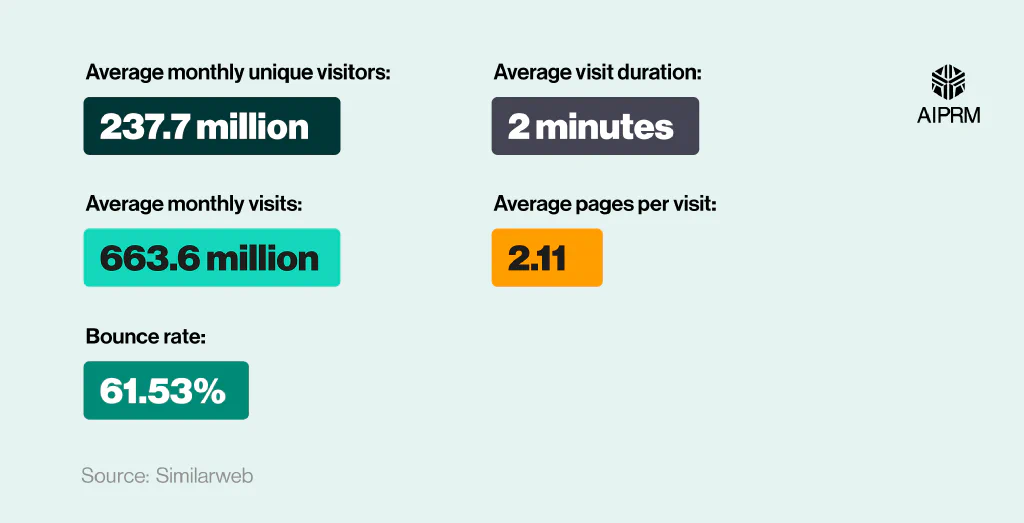
Across the 237.7 million unique visitors, the OpenAI website receives 663.6 million monthly visits on average.
To break this down further, there are around 2.79 visits per month to OpenAI per unique visitor.
Average visit duration on OpenAI #
From April to June 2025, the average visit duration on OpenAI’s website was exactly two minutes.
This is in line with OpenAI bounce rate statistics, which show that the site has a rate of 61.53%, indicating that three in five visitors view only one page on-site before exiting.
Number of pages per visit on OpenAI #
Despite a bounce rate of 61.53%, the average number of pages viewed per visit to OpenAI’s website in the same period was just over two (2.11).
Most popular countries for OpenAI usage #
The United States is the most popular country for OpenAI usage. With a traffic share of 14.13%, nearly one in every seven visitors is located in the US.
The five countries with the greatest traffic share for OpenAI (April to June 2025) #
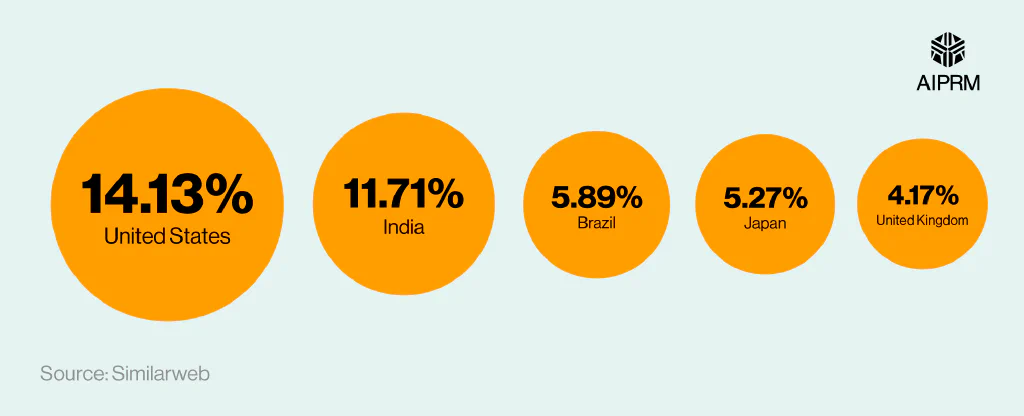
India is the only other country to have a traffic share of over 10%, accounting for over one in nine visitors.
North America, South America, and Europe are all represented in the most popular countries for OpenAI usage, but only Asia ranks with two countries – India (11.71%) and Japan (5.27%).
Age distribution of OpenAI usage statistics #
Those aged between 25 and 34 represent the greatest number of OpenAI website users, with nearly three in 10 (28.84%) coming from this age group.
The age distribution of OpenAI website users (April to June 2025) #
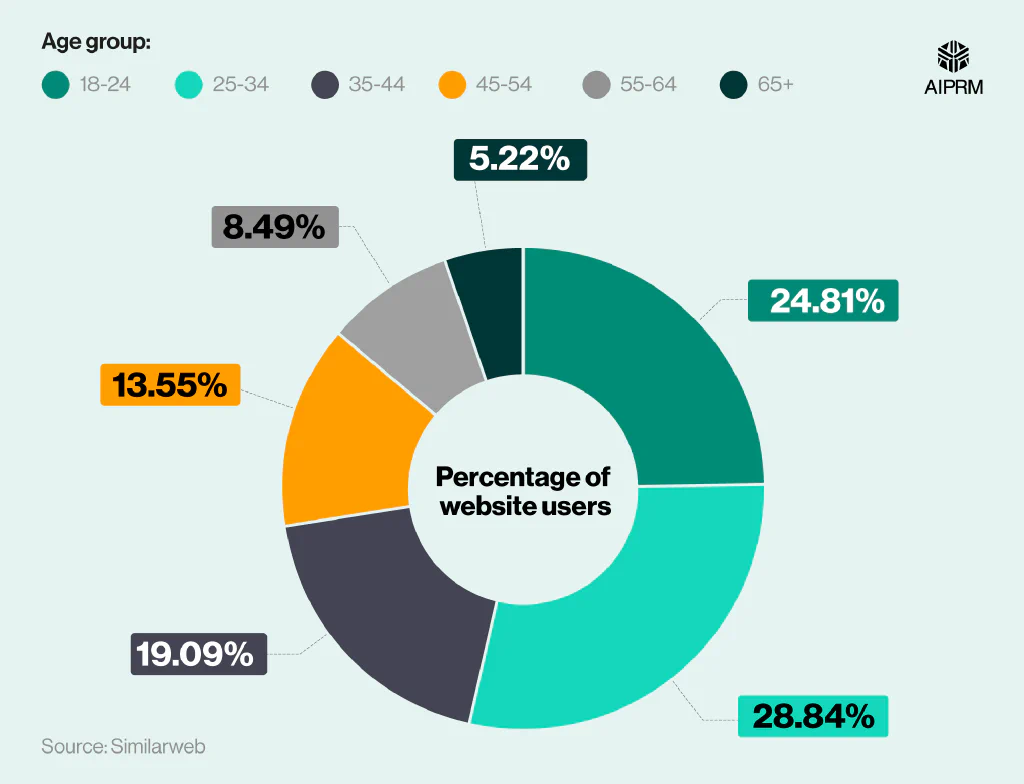
The second-highest proportion of users is between 18 and 24 years old, this group accounts for just under a quarter (24.81%) of OpenAI website users.
The age distribution of OpenAI website users increases between 18 and 34 years old, and then gradually declines, with those aged 65+ representing just over one in every 20 users.
Gender distribution of OpenAI usage statistics #
The majority of OpenAI website users are male, accounting for more than half of the site’s users.
The gender distribution of OpenAI website users (April to June 2025) #
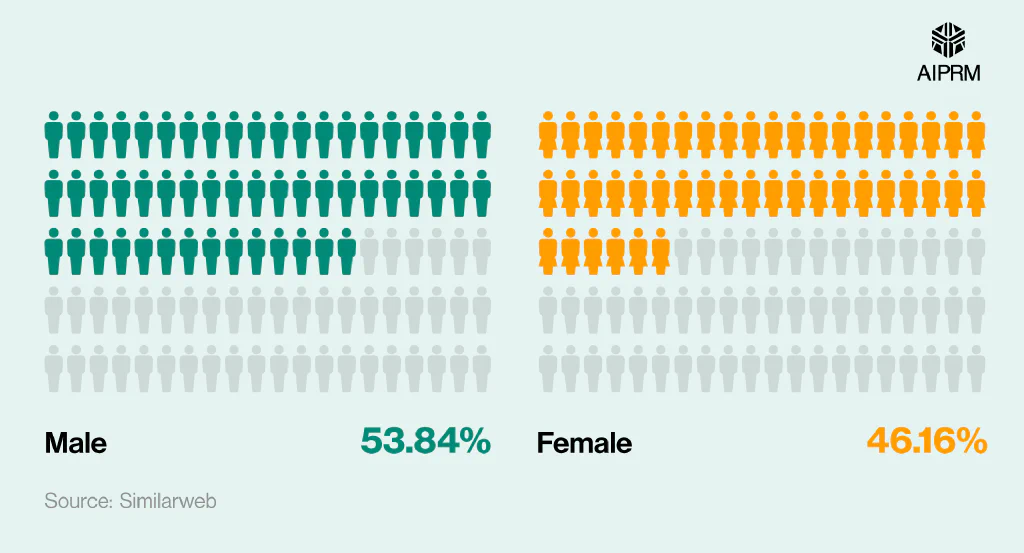
By comparison, women represent more than two in five OpenAI website users, with a share of 46.16%.
OpenAI usage statistics by industry #
According to data from Enlyft, companies in the IT services industry are most likely to work with OpenAI around the world, with 1,171 companies and organizations reported to use OpenAI in their business processes.
Computer software had the second-highest number of companies, at 1,070, showing a strong demand for OpenAI services among the IT sectors. This was more than double the total of the next highest sector, making computer software the only other industry with more than 1,000 OpenAI-using companies.
The industries with the most companies/organizations using OpenAI, worldwide #
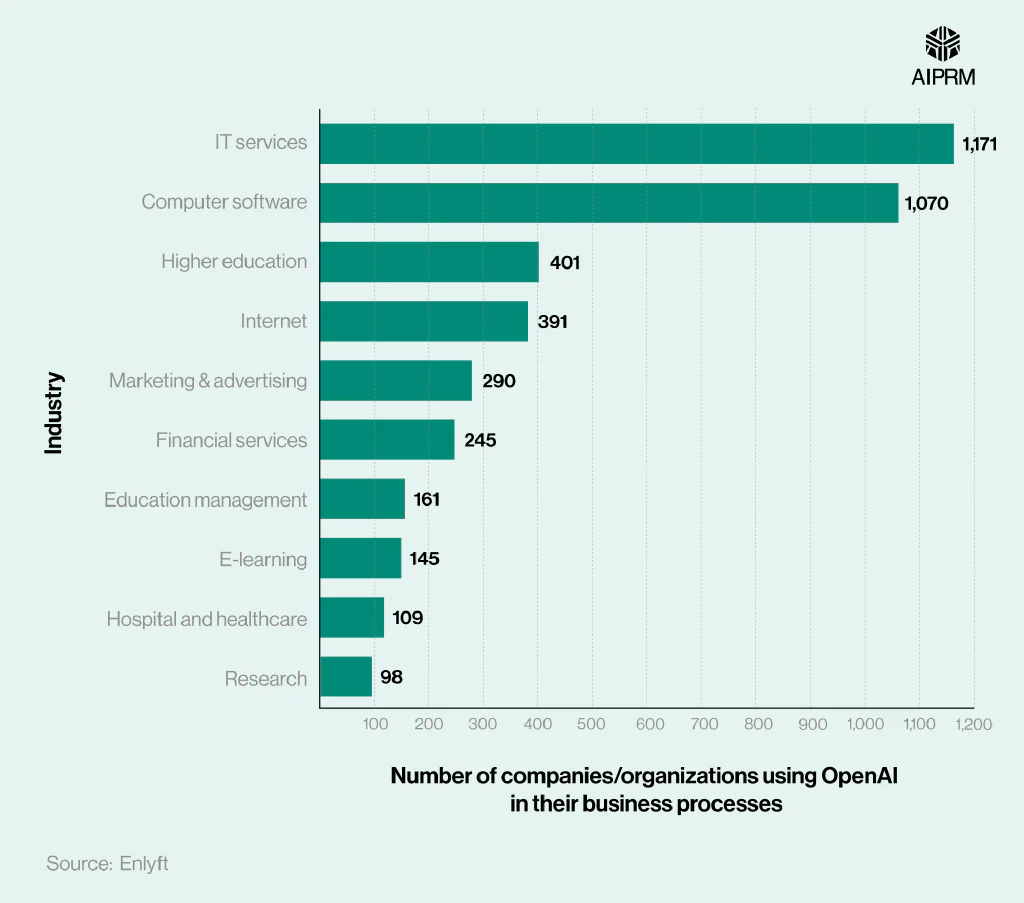
Higher education staff are reaping the opportunities provided by using AI in education, with 401 organizations reported to be using OpenAI.
There are many industries where OpenAI use is beginning to become more commonplace, including internet, marketing-advertising, and financial services (391, 290, and 245 companies, respectively).
OpenAI usage statistics by company size #
Companies with between 10 and 50 employees are most likely to use OpenAI, with over 1,400 businesses of this size using the company’s products in their operations. This was slightly more than companies with 50 to 200 employees (1,275), which was the only other company size with more than 1,000 businesses using OpenAI.
The number of companies using OpenAI, by company size, worldwide #
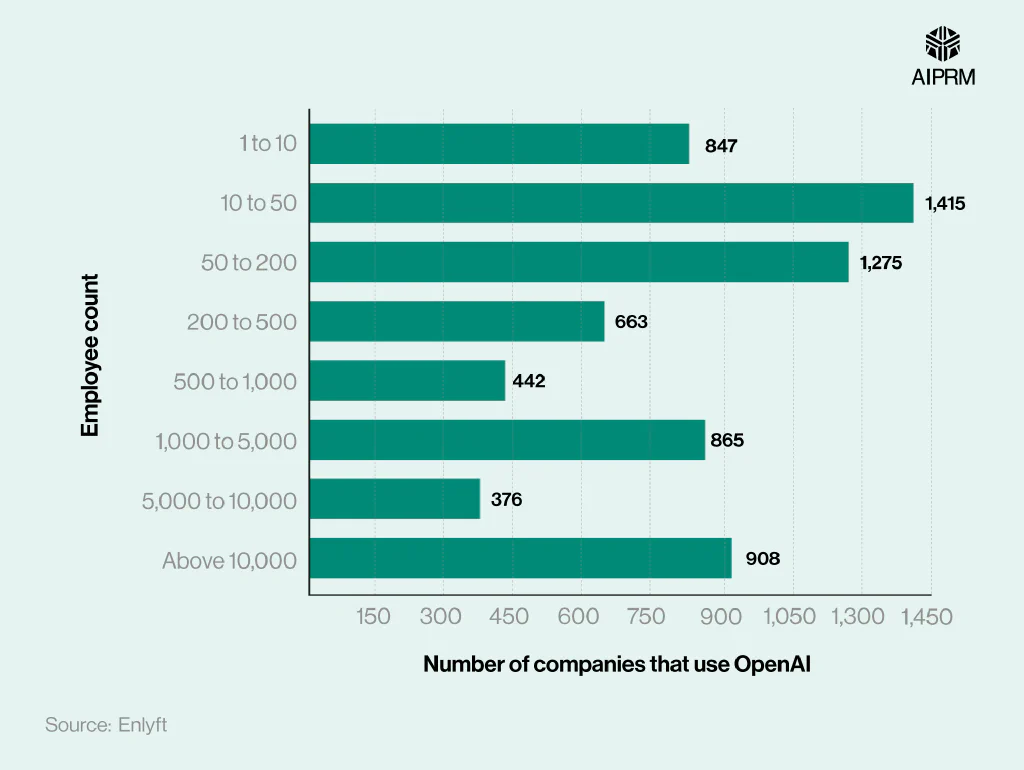
OpenAI also holds significant popularity among the biggest companies, with over 900 businesses with over 10,000 employees incorporating OpenAI services into their business operations.
At the other end of the scale, just 376 companies with 5,000-10,000 employees used OpenAI services, nearly four times fewer than those with 10 to 50 employees.
OpenAI usage statistics by company revenue #
Recent OpenAI statistics revealed that the most prominent users of OpenAI in terms of revenue are those in the $1-$10 million bracket, with 1,643 companies in this bracket reportedly using OpenAI services.
This is followed by those earning $10-$50 million, with over 1,300 companies in this category incorporating OpenAI into their operations.
The number of companies using OpenAI, by company revenue, worldwide #
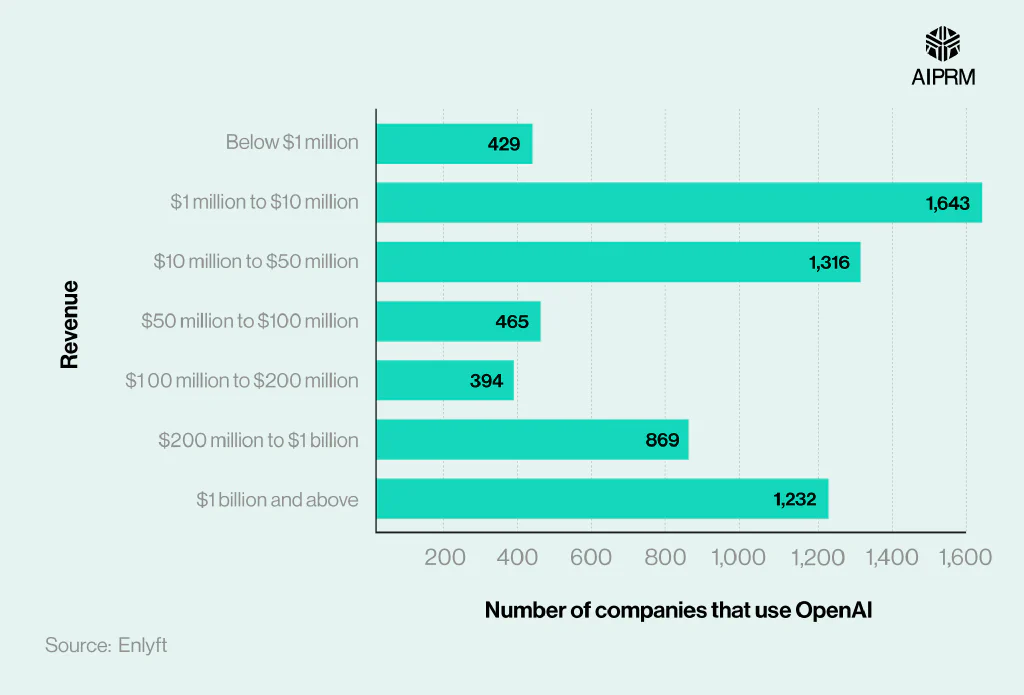
Interestingly, the next highest peak in use cases can be found among the biggest companies, with 1,232 companies with revenue exceeding $1 billion using OpenAI. This was nearly three times more than the number of companies with earnings below $1 million, and the final bracket with more than a thousand OpenAI-using businesses.
Main social media traffic to OpenAI #
When looking at desktop data, the leading social media platform driving traffic to OpenAI is YouTube, accounting for more than two-fifths (42.18%) of the site’s traffic between April and June 2025.
The desktop social media sites that drive the most traffic to the OpenAI website (April to June 2025) #
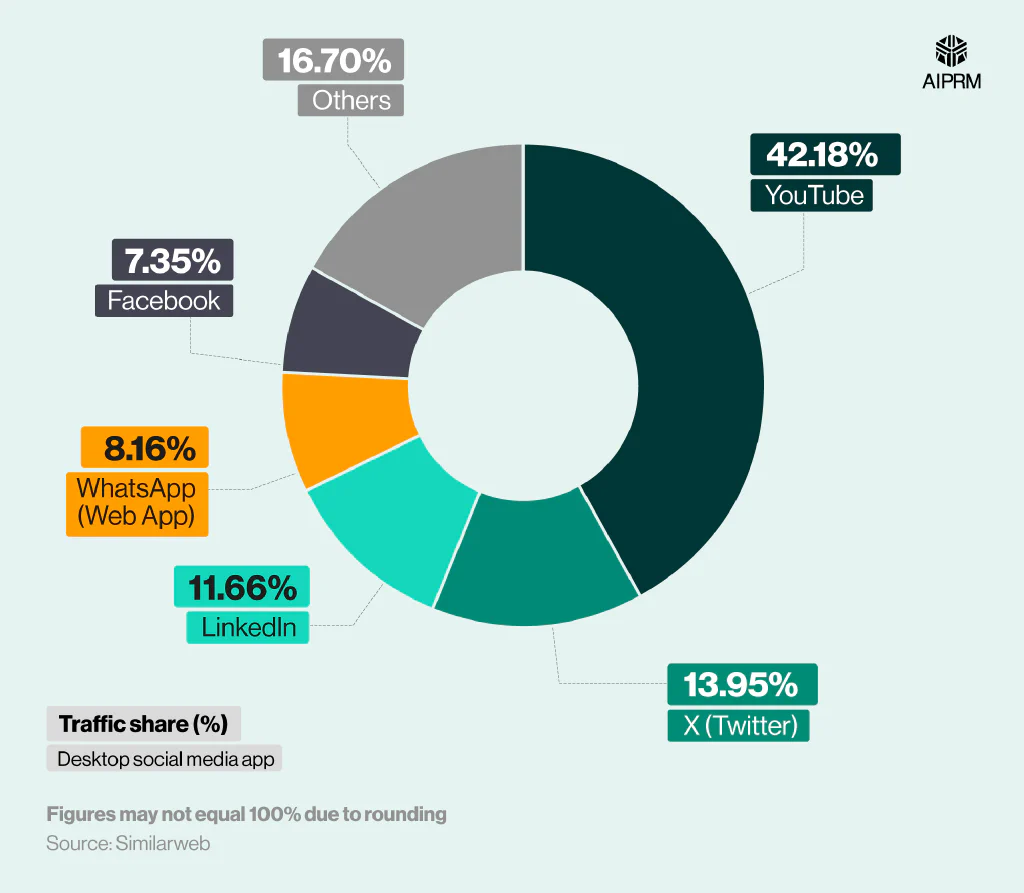
The next biggest driver is X, driving 13.95% of OpenAI’s desktop social media traffic.
LinkedIn is the third-biggest driver of traffic to OpenAI’s site, at 11.66%, followed by WhatsApp Web (8.16%) and Facebook (7.35%). According to AI replacing job statistics, in the year to November 2023, there was a 21x increase in English-language job adverts mentioning OpenAI’s products GPT and ChatGPT.
Statistics on the different products of OpenAI #
OpenAI token cost #
OpenAI tokens are units used to measure the amount of text processed by language models like GPT, ranging from one character (like a period) to a short word (like “but”). Longer words are typically split into multiple tokens.
As of August 2025, tokens for GPT-5 are priced at $1.25 per million input tokens, while cached prompts - where OpenAI routes API prompts to servers that have recently processed the same prompt - cost $0.125 per million input tokens.
ChatGPT statistics: Cost #
A report from Reuters via The Information revealed that running ChatGPT could be costing OpenAI a significant amount of money. The global news agency reported that OpenAI had raised projected losses to $115 billion through 2029, with increased spending on ChatGPT thought to be a driving factor.
This followed previous reports, which estimated that OpenAI was likely to spend as much as $7 billion on training and operating its chatbot in 2024.
This estimate was based on predicted costs, including $4 billion to rent server capacity from Microsoft and $3 billion to cover the cost of training the AI models on new data (including copyright deals with publishers).
ChatGPT usage statistics: Website visits #
In the first month of its launch, OpenAI’s ChatGPT product received 152.7 million visits. As of June 2025, monthly visits have increased by 3,433% to nearly 5.4 billion.
Monthly visits to ChatGPT (November 2022 to June 2025) #
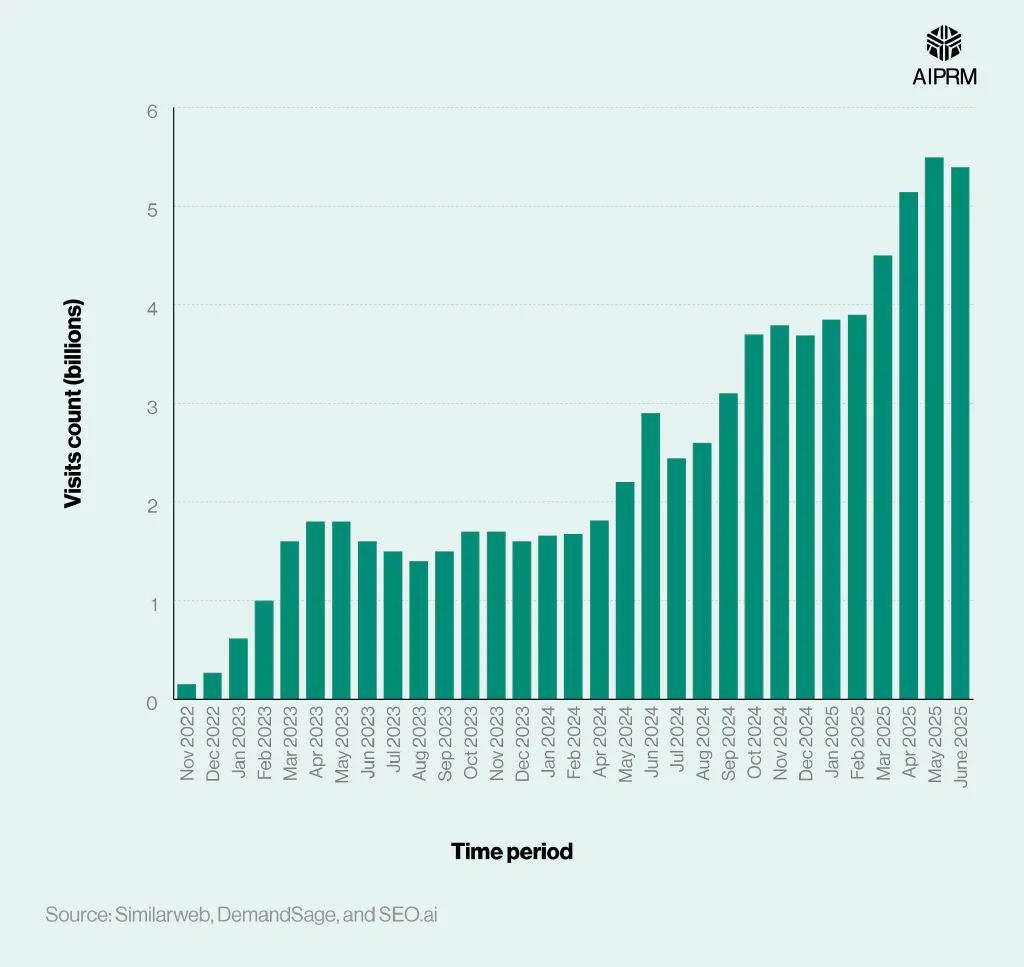
Despite this impressive growth, monthly visits to ChatGPT have fluctuated over the years analyzed. The greatest month-on-month growth was seen in January 2023, when monthly visits increased by nearly 132% to 616 million.
Meanwhile, the greatest drop in monthly visits was reported in June 2023, when visits dropped by around 11%, from 1.8 billion to 1.6 billion.
According to ChatGPT statistics, the product had 180 million users as of December 2023, with this number reaching 700 million weekly users by July 2025.
ChatGPT usage statistics: Countries #
Data from Similarweb shows that people in the United States use ChatGPT the most, accounting for nearly 15% of users.
The distribution of ChatGPT users by country (April to June 2025) #
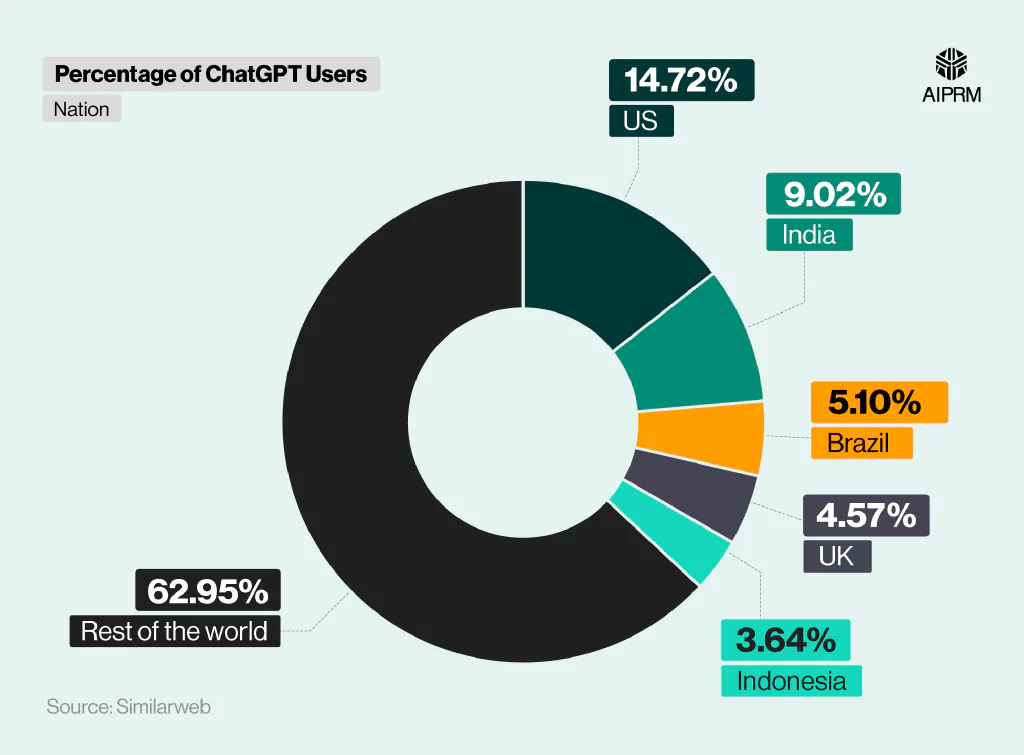
Those in India represent the second-most ChatGPT users, with 9.02%. This is followed by Brazil (5.10%), the UK (4.57%), and Indonesia (3.64%).
Overall, this means that the five most prominent nations for ChatGPT use account for less than two-fifths of its total usage, highlighting its diverse and widespread global popularity.
OpenAI Five statistics #
OpenAI Five is a team of five neural networks trained to play the online multiplayer game Dota 2.
Training on self-play, the model plays 180 years’ worth of the game against itself every day.
In April 2019, OpenAI Five beat the Dota 2 world champions, team OG, in two back-to-back games at the OpenAI Five Finals. This marked the first time an AI team beat a champion team at any esports game and the first time that any team was defeated by an AI on a live stream (after previous wins against other professionals were held privately).
The Future of OpenAI #
Speaking at the Aspen Ideas Festival in June 2024, CEO Sam Altman argued that the future of artificial intelligence as a whole is in developing new ways to teach AI models, beyond training them on existing knowledge.
Further, OpenAI’s mission statement encompasses their plans: “Our mission is to ensure that artificial general intelligence benefits all of humanity”.
Currently, Artificial General Intelligence (AGI) is a theoretical concept rather than a tangible product, where an AI would possess human-level cognitive abilities to understand, learn, and apply knowledge across a variety of intellectual tasks. However, numerous key people in the AI arena are certain that AGI is possible.
In a set of essays released to his site in June 2024, Leopold Aschenbrenner, an AI researcher and former “superalignment” employee at OpenAI, stated that he believes “AGI by 2027 is strikingly plausible”.
![Mini infographic with the text ‘Leopold Aschenbrenner, AI researcher and former OpenAI employee, stated in June 2024 that he believes “AGI [Artificial General Intelligence] by 2027 is strikingly plausible”.’](/en-ie/openai-statistics/_hu305d33c11aff3e0d10478dc584e29ef7_464913_c87bfc837ddb5ee21b366db4b9ec3364.webp)
OpenAI has set out a charter of guidelines they will follow in their pursuit of AGI:
- Broadly distributed benefits: The company believes AGI should be, and can be, beneficial to all of humanity.
- Long-term safety: OpenAI is committed to undertaking the necessary research to make AGI safe and states they are concerned about competitiveness overtaking safety. To avoid this, they have stated that if a similar product emerges that is closer to achieving AGI, OpenAI will stop competing and start assisting them.
- Technical leadership: The company seeks to be on the cutting edge of all things AI, setting the standard for AGI advancements.
- Cooperative orientation: OpenAI wants the global community to work together to address AGI’s challenges, and in pursuit of this, they publish much of their AGI research.
FAQs about OpenAI #
What is OpenAI?
OpenAI describes itself as “an AI research and deployment company”, whose mission is to create AGI systems. Founded in 2015, the company has released the following products:
- OpenAI Five: An AI system trained to play the video game Dota 2.
- GPT: A language model incorporating transformers for a diverse range of text generation and natural language processing tasks.
- DALL·E: A program that creates images based on user prompts.
- OpenAI Codex: A system that creates code from reading natural language.
- ChatGPT: A chatbot that uses natural language processing to engage in human-like conversational dialogue.
- SearchGPT: A prototype search engine created by OpenAI in July 2024.
- Sora: OpenAI product that creates videos based on user prompts.
- OpenAI API: A programming interface enabling users to integrate functions from OpenAI tools into their projects, tasks, and operations.
- ChatGPT Agent: A virtual assistant that allows users to carry out complex, multi-step tasks like online research, interacting with websites, and filling out forms.
- Deep Research: A comprehensive research system that analyzes and synthesizes high volumes of online sources to create a comprehensive report on a chosen subject.
Who owns OpenAI?
OpenAI has a two-fold structure. The nonprofit OpenAI, Inc. controls the company’s direction and holds an equity stake, while the capped-for-profit subsidiary, OpenAI Global, LLC, is responsible for commercial affairs.
Microsoft, OpenAI’s biggest investor, has reportedly invested $13 billion in OpenAI and is entitled to 49% of OpenAI Global, LLC’s profits until it has reached ten times the invested figure. A significant proportion of the remaining equity is split amongst other entities, including venture capital investors Khosla Ventures, Sequoia, and Thrive Capital.
However, as a result of OpenAI’s two-fold structure (the nonprofit OpenAI, Inc. and the for-profit OpenAI Global, LLC.), Microsoft does not have ultimate control over decisions, as the nonprofit OpenAI, Inc. is the sole controlling member in the for-profit.
How much is OpenAI worth?
As of July 2025, OpenAI is reportedly worth around $300 billion, following a $40 billion funding round in March of that year.
How to invest in OpenAI
Currently, you cannot invest in OpenAI as it is not a publicly traded company. However, you can indirectly invest in OpenAI by buying stocks in Microsoft, one of the company’s greatest private funders.
How to use Sora OpenAI
To use OpenAI’s Sora, you must have a ChatGPT Plus or ChatGPT Pro subscription. With the Plus plan, users can create videos up to 10 seconds long, though 720p quality is usually limited to shorter clips and may drop to around 480p for full-length videos. The Pro plan extends this capability, allowing videos up to 20 seconds with enhanced resolution of 1080p.
Glossary #
AGI #
AGI stands for Artificial General Intelligence and describes AI systems that are generally smarter than humans. Currently, a theoretical concept, companies such as OpenAI are devoted to building this technology.
Rather than focus on specific tasks, such as creating a picture from a user prompt (as performed by DALL·E or GPT‑4o image generation), AGI aims to develop systems that can problem-solve and display creative reasoning, with minimal task‑specific human intervention.
OpenAI Codex #
OpenAI Codex is a cloud-based software engineering agent capable of managing multiple tasks in parallel. It can write new features, answer questions about a codebase, fix bugs, and propose pull requests for review.
OpenAI DALL·E #
A deep learning model that can generate images from the user’s textual descriptions.
OpenAI GPT-5 #
GPT-5 is the latest flagship model of OpenAI. It is a unified system that combines multiple models - a fast model for quick responses and a deeper reasoning model for complex problems. A smart router automatically decides which model to use based on the user’s question’s complexity.
OpenAI Sora #
A text-to-video model released by OpenAI. Sora generates video from users’ text prompts, and can also be used to extend existing short videos.
Superalignment #
A research project undertaken by OpenAI to come up with ways to control a hypothetical superintelligence.
Our definitive AI glossary covers all the terms you need to know about generative AI, from deep learning to understanding the nuances of GANs.
Sources #
https://www.law.cornell.edu/wex/public_benefit_corporation
https://www.nytimes.com/2024/02/16/technology/openai-artificial-intelligence-deal-valuation.html
https://www.theguardian.com/technology/2024/oct/02/openai-raises-66bn-in-funding-is-valued-at-157bn
https://www.reuters.com/technology/openai-valued-80-billion-after-deal-nyt-reports-2024-02-16/
https://taptwicedigital.com/stats/openai
https://medium.com/@lotussavy/the-curious-case-of-sam-altmans-stake-in-openai-7bf1567fb9e2
https://openai.com/index/scale-the-benefits-of-ai/
https://backlinko.com/chatgpt-stats
https://www.cnbc.com/2025/08/08/chatgpt-gpt-5-openai-altman-loss.html
https://finance.yahoo.com/news/openai-sees-5-billion-loss-170306927.html
https://6sense.com/tech/artificial-intelligence/openai-market-share
https://openai.com/our-structure/
https://openai.com/index/microsoft-invests-in-and-partners-with-openai/
https://openai.com/index/announcing-the-stargate-project/
https://forgeglobal.com/openai_stock/
https://fortune.com/2024/03/01/how-much-is-openai-billionaire-sam-altman-worth/
https://www.theguardian.com/technology/2024/mar/08/openai-sam-altman-reinstated
https://www.theinformation.com/articles/openai-says-business-will-burn-115-billion-2029
https://www.businessinsider.com/open-ai-sam-altman-equity-stake-valuation-private-nonprofit-9
https://fortune.com/2024/09/30/sam-altman-openai-equity-stake-billionaire/
https://www.answeriq.com/openai-statistics/
https://www.levels.fyi/companies/openai/salaries
https://growjo.com/company/OpenAI
https://enlyft.com/tech/products/openai
https://www.similarweb.com/website/openai.com/#overview
https://www.worldometers.info/world-population/
https://www.enterpriseappstoday.com/stats/openai-statistics.html
https://situational-awareness.ai/
https://www.demandsage.com/chatgpt-statistics/
https://seo.ai/blog/how-many-users-does-chatgpt-have
https://pbs.twimg.com/media/GSyWp3GbYAAsmcI?format=png&name=4096x4096
https://www.theinformation.com/articles/why-openai-could-lose-5-billion-this-year
https://deadline.com/2024/07/openai-chatgpt-home-may-lose-5b-this-year-1236024704/
https://www.semafor.com/article/03/24/2023/the-secret-history-of-elon-musk-sam-altman-and-openai
https://www.aiprm.com/ai-replacing-jobs-statistics/
https://openai.com/index/openai-five-defeats-dota-2-world-champions/
https://www.forbes.com/sites/bernardmarr/2024/05/20/the-crucial-difference-between-ai-and-agi/
https://explodingtopics.com/blog/chatgpt-users
https://www.datacamp.com/tutorial/guide-to-openai-api-on-tutorial-best-practices
https://x.com/leopoldasch/status/1798068281414414350?lang=en
https://openai.com/careers/ai-deployment-manager-san-francisco/
https://openai.com/index/openai-five/
https://situational-awareness.ai/from-gpt-4-to-agi/
https://openai.com/sora/#pricing
https://www.standard.co.uk/news/tech/who-owns-openai-chatgpt-microsoft-b1121742.html
https://medium.com/towards-agi/sora-pricing-explained-can-chatgpt-plus-users-use-it-6ecb3684eba7